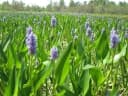
Pontederia cordata
Pontederia cordata
Safety & Hazards
None known
Cultivation Details
Pickerel weed has a very wide natural range from the cold temperate zone to the tropics. It can be grown in the tropics at elevations from sea level to 1,500 metres[1]. It grows best in areas where annual daytime temperatures are within the range 14 - 24°c, but can tolerate 10 - 30°c[1]. When dormant, the plant can survive temperatures down to about -25°c, but young growth can be severely damaged at 0°c[1]. It prefers a mean annual rainfall in the range 800 - 1,200mm, but tolerates 500 - 1,500mm[1]. Grows best in a sunny position[1]. A water or bog garden plant, it requires a rich soil[2] and prefers growing in water 15 - 30 cm deep[3]. Tolerates a wide range of fertile soils[1]. Prefers a pH in the range 6 - 7.5, tolerating 5.5 - 8[1]. There is a species of bee (Dufourea novae-angliae) which visits this plant for nectar and pollen and does not visit any other species of plant[4]. The reproductive biology of Pontederia cordata has been well studied. It is a tristylous species, and most populations contain all three forms. At least some degree of self-incompatibility exists, being strongest with the short-style forms and weakest with the midstyle forms[5].
Propagation
Seed - best sown as soon as it is ripe in pots standing in 2cm of water in a cold frame. Cover the seed lightly with silver sand. Submerse in 3cm depth of water after the seedlings emerge[6]. When they are large enough to handle, prick the seedlings out into individual pots and grow them on in water in the greenhouse for their first winter. Plant them out into their permanent positions in late spring or early summer, after the last expected frosts. Division is best in mid spring but it can be done at almost any time of the year[3]. Very easy, larger divisions can be planted out direct into their permanent positions. We have found that it is better to pot up the smaller divisions and grow them on in light shade in a cold frame until they are well established before planting them out in late spring or early summer. Lateral shoots. Cite as: Temperate Plants Database, Ken Fern. temperate.theferns.info. 2026-02-21. <temperate.theferns.info/plant/Pontederia+cordata>
Pollinators
Bees
References
- [1]Ecocrop — http://ecocrop.fao.org/ecocrop/srv/en/home ↩︎Basic information on a wide range of useful plants, plus details of environmental needs where available.
- [2]Complete Guide to Water Plants. — Muhlberg. H. · E. P. Publishing Ltd. · 1982 · ISBN 0-7158-0789-7 ↩︎Deals with a wide range of plants for temperate areas (and indoor aquaria) with quite a lot of information on cultivation techniques.
- [3]RHS Dictionary of Plants plus Supplement. 1956 — F. Chittendon. · Oxford University Press · 1951 · ISBN - ↩︎Comprehensive listing of species and how to grow them. Somewhat outdated, it has been replaced in 1992 by a new dictionary (see [ 200 ]).
- [4]Flowering Plants of the World. — Haywood. V. H. · Oxford University Press · ISBN 0-19-217674-9 ↩︎Very readable and well illustrated, it lists plants by families giving the basic diagnostic features and some details of plant uses.
- [5]Flora of N. America — http://flora.huh.harvard.edu/fna/ ↩︎An on-line version of the flora with an excellent description of the plant including a brief mention of plant uses.
- [6]The New RHS Dictionary of Gardening. 1992. — Huxley. A. · MacMillan Press · 1992 · ISBN 0-333-47494-5 ↩︎Excellent and very comprehensive, though it contains a number of silly mistakes. Readable yet also very detailed.
- [7]Perennials. Volumes 1 and 2. — Phillips. R. & Rix. M. · Pan Books · 1991 · ISBN 0-330-30936-9 ↩︎Photographs of over 3,000 species and cultivars of ornamental plants together with brief cultivation notes, details of habitat etc.
- [8]Eat the Weeds. — Harris. B. C. · Pivot Health · 1973 · ISBN - ↩︎Interesting reading.
- [9]A Field Guide to N. American Edible Wild Plants. — Elias. T. and Dykeman. P. · Van Nostrand Reinhold · 1982 · ISBN 0442222009 ↩︎Very readable.
- [10]The Dictionary of Useful Plants. — Coon. N. · Rodale Press · 1975 · ISBN 0-87857-090-x ↩︎Interesting reading but short on detail.
- [11]Cornucopia - A Source Book of Edible Plants. — Facciola. S. · Kampong Publications · 1990 · ISBN 0-9628087-0-9 ↩︎Excellent. Contains a very wide range of conventional and unconventional food plants (including tropical) and where they can be obtained (mainly N. American nurseries but also research institutes and a lot of other nurseries from around the world.
- [12]Cornucopia II — Facciola. S. · Kampong Publications, California. · 1998 · ISBN 0-9628087-2-5 ↩︎The second edition of an excellent guide to the edible uses of plants, though it does not give any details of cultivation etc.
- [13]Native American Ethnobotany — Moerman. D. · Timber Press. Oregon. · 1998 · ISBN 0-88192-453-9 ↩︎Very comprehensive but terse guide to the native uses of plants. Excellent bibliography, fully referenced to each plant, giving a pathway to further information. Not for the casual reader.