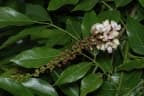
Cultivation Details
Native to humid tropical and subtropical environments, it is found at elevations from sea level to 1,200 metres[2]. It grows in areas where the mean annual temperature ranges from a minimum of 1 - 16°c, up to a maximum of 27 - 38 (exceptionally 50)°c, and the mean annual rainfall is 500 - 2,500 mm, with a dry season of 2 - 6 months[2]. Mature plants can tolerate light frosts[2]. The plant can grow on most soil types[2]. The best growth is found on deep well-drained sandy loams with assured moisture, but it will also grow on sandy soils and heavy swelling clay soils[2]. It does not do well on dry sands, although it tolerates saline conditions, alkalinity and waterlogged soils[2]. Tolerant of shade, it can grow under the shade of other trees, but will also grow well in full sun[2]. Established plants are drought resistant[2]. Plants are wind-resistant, tolerating at least some salt-laden air[1]. Plants become nutrient deficient if growing in soils with a pH higher than 7.5[1]. The plant has a long, thick taproot and widely spreading lateral roots[3]. The spread of roots on this species, about 9 metres in 18 years, is greater than most other species; moreover it produces root suckers profusely[2]. Because of these characteristics, pongam is unsuitable for agroforestry and has the potential to become a weed if not managed carefully[2]. Pod production commences when seedlings are 5 - 7 years old[2]. The pods do not open naturally, and must decay before the seeds can germinate[2]. Individual trees yield 9 - 90 kg of pods annually, while mature trees yield 8 - 24 kg of seeds annually[2]. Growth of young trees is fairly slow; a growth of 1.3 metres in height and 0.4 cm in diameter in 13 months was recorded in India[2]. Trees coppice well and can also be pollarded[2]. When planted as a shade or ornamental tree, pruning may be necessary to obtain a trunk of appropriate height[2]. This species has a symbiotic relationship with certain soil bacteria, these bacteria form nodules on the roots and fix atmospheric nitrogen. Some of this nitrogen is utilized by the growing plant but some can also be used by other plants growing nearby[4].
Propagation
Seed - requires no pre-treatment. The seed is usually sown in situ, germinating within 1 - 5 weeks of sowing[2]. Germination is hypogeal and the radicle develops quickly before the plumule emerges[2]. If sown in a nursery bed, the seed can be planted at a close spacing, as young plants tolerate shade well - a spacing of 7.5 x 15 cm is recommended[2]. Seedlings attain a height of 25 - 30 cm in their first growing season[2]. Transplanting to the field should occur at the beginning of the next rainy season when seedlings are about 60 cm in height[2]. Seedlings have large root systems and soil should be retained around the roots during transplanting[2]. Seed storage behaviour is orthodox and seeds remain viable for about a year when stored in air-tight containers[2]. Natural reproduction is profuse by seed and common by root suckers[2]. Spontaneous seedlings and root suckers are produced and may cause serious weed problems[2]. Stump cuttings of 1 - 2 cm root-collar diameter[2]. Branch cuttings[2]. Root suckers[2]. Cite as: Tropical Plants Database, Ken Fern. tropical.theferns.info. 2026-02-20. <tropical.theferns.info/viewtropical.php?id=Pongamia+pinnata>
Pollinators
Data unavailable
References
- [1]Institute of Food and Agricultural Sciences, University of Florida — University of Florida · http://hort.ifas.ufl.edu/shrubs/ ↩︎PDF fact sheets on over 500 shrubs.
- [2]World Agroforesty Centre — http://www.worldagroforestry.org/ ↩︎An excellent online database of a huge range of trees giving very good information on each plant - its uses, ecology, identity, propagation, pests etc.
- [3]Forest, Farm, and Community Tree Network — http://www.winrock.org/fnrm/factnet/factnet.htm ↩︎A series of in-depth factsheets on a wide range of plants, especially leguminous trees.
- [4]The New RHS Dictionary of Gardening. 1992. — Huxley. A. · MacMillan Press · 1992 · ISBN 0-333-47494-5 ↩︎Excellent and very comprehensive, though it contains a number of silly mistakes. Readable yet also very detailed.
- [5]Plants and People of Nepal — Manandhar. N. P. · Timber Press. Oregon. · 2002 · ISBN 0-88192-527-6 ↩︎Excellent book, covering over 1,500 species of useful plants from Nepal together with information on the geography and peoples of Nepal. Good descriptions of the plants with terse notes on their uses.