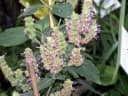
Pogostemon cablin
Pogostemon cablin
Safety & Hazards
None known
Cultivation Details
Patchouli is a plant of the moist tropics, where it is found at elevations from 1,000 - 2,000 metres. It grows best in areas where annual daytime temperatures are within the range 23 - 28°c, but can tolerate 16 - 32°c[1]. The plant can survive temperatures down to about 5°c[1]. It prefers a mean annual rainfall in the range 2,200 - 2,600mm, but tolerates 2,000 - 2,800mm[1]. Grows best in a sunny position[1]. Requires a rich, moist soil[2]. Grows best in a fertile, well-drained, loamy to clayey soil[1]. Prefers a pH in the range 6 - 6.5, tolerating 5.5 - 7[1]. All parts of the plant are aromatic when crushed[3]. The plant is often cultivated for its essential oil[3]. A short-lived, perennial species, it provides a first harvest 180 - 210 days after planting, and can be cropped thereafter every 120 - 180 days[1]. Yields from the first cutting are about 1 tonne of dried leaves per hectare. Subsequent cuttings give 0.5 - 1 tonnes[1]. The plant has an economical life of 2- 3 years[1].
References
- [1]Ecocrop — http://ecocrop.fao.org/ecocrop/srv/en/home ↩︎Basic information on a wide range of useful plants, plus details of environmental needs where available.
- [2]Encyclopaedia of Herbs and their Uses. — Bown. D. · Dorling Kindersley, London. · 1995 · ISBN 0-7513-020-31 ↩︎A very well presented and informative book on herbs from around the globe. Plenty in it for both the casual reader and the serious student. Just one main quibble is the silly way of having two separate entries for each plant.
- [3]Minor Products of Philippine Forests — Brown. W. H. · Bureau of Forestry, Manilla. · 1920 ↩︎A useful guide to some of the plants of the area, though terse on details. The book is out of copyright and can be legally downloaded from the Internet.
- [4]Philippine Medicinal Plants — http://www.stuartxchange.org/CompleteList.html ↩︎A lovely site, giving brief details on the medicinal uses of several hundred (over 400 at the last count) plants in the Philippines, plus a picture of each plant.
- [5]A taxonomic revision of Pogostemon (Lamiaceae) from China — Yao, G., Deng, Y.F. & Ge, X.J. · Magnolia Press; Aukland · 2015 · http://dx.doi.org/10.11646/phytotaxa.200.1.1 · ISBN 978-1-77557-650-1 ↩︎
- [6]Dictionary of Economic Plants. — Uphof. J. C. Th. · Weinheim · 1959 · ISBN - ↩︎An excellent and very comprehensive guide but it only gives very short descriptions of the uses without any details of how to utilize the plants. Not for the casual reader.
- [7]Cornucopia II — Facciola. S. · Kampong Publications, California. · 1998 · ISBN 0-9628087-2-5 ↩︎The second edition of an excellent guide to the edible uses of plants, though it does not give any details of cultivation etc.
- [8]The Encyclopedia of Medicinal Plants — Chevallier. A. · Dorling Kindersley. London · 1996 · ISBN 9-780751-303148 ↩︎An excellent guide to over 500 of the more well known medicinal herbs from around the world.
- [9]Medicinal Plants of the Guianas — DeFilipps, R. A.; Maina, S. L.; & Crepin, J. · Smithsonian Museum · http://botany.si.edu/bdg/medicinal/index.html ↩︎A down-loadable PDF document of a book in pre-publication awaiting illustration. An excellent, if rather terse, guide to the traditional medicinal uses of the plants of the region