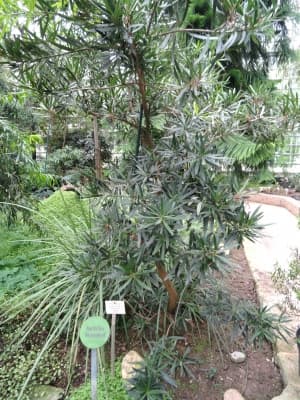
Podocarpus rumphii
Podocarpus rumphii
Safety & Hazards
None known
Cultivation Details
Based on data from 42 collection localities, Podocarpus rumphii grows in a region where the mean annual temperature is 22°c, with an average minimum in the coldest month of 16°c, and a mean annual precipitation of 2790mm[1]. In Jawa the tree is found on limestone, on other islands it is also found on soils ranging from clay to sand derived from acidic rock types[2]. In tall forest (with a canopy 40 - 50 metres high) it can reach into the canopy, successfully competing with angiosperms[2]. The large leaves of saplings to pole stage trees could be an adaptation to growing in shade under other trees; they become smaller, narrower and more leathery and stiff in sun-exposed crowns of larger trees[2]. Species in this genus are generally slow-growing[2]. A dioecious species; both male and female forms need to be grown if fruit and seed are required.
Propagation
The seed can be sown at any time of the year in a sandy soil, though it is probably best sown as soon as it is ripe[3]. When they are large enough to handle, prick the seedlings out into individual pots and grow them on until large enough to plant out. Cuttings of half-ripe terminal shoots, 5 - 10cm long, in a frame[4]. Cite as: Tropical Plants Database, Ken Fern. tropical.theferns.info. 2026-02-20. <tropical.theferns.info/viewtropical.php?id=Podocarpus+rumphii>
Pollinators
Wind
References
- [1]The Gymnosperm Database — http://www.conifers.org/index.htm ↩︎A vast amount of information on conifers and families of gymnosperms.
- [2]IUCN Red List of Threatened Species — http://www.iucnredlist.org/ ↩︎A list of plants under threat and facing possible extinction, usually with brief details of the threats and information on habitat.
- [3]RHS Dictionary of Plants plus Supplement. 1956 — F. Chittendon. · Oxford University Press · 1951 · ISBN - ↩︎Comprehensive listing of species and how to grow them. Somewhat outdated, it has been replaced in 1992 by a new dictionary (see [ 200 ]).
- [4]Propagation of Trees, Shrubs and Conifers. — Sheat. W. G. · MacMillan and Co · 1948 · ISBN - ↩︎A bit dated but a good book on propagation techniques with specific details for a wide range of plants.
- [5]Tropical and Subtropical Trees - A Worldwide Encyclopaedic Guide. — Barwick. M. · Thames & Hudson, London · 2004 · ISBN 0-500-51181-0 ↩︎A superb book, very concise and well written, giving a wealth of information on 400 or more species including descriptions, habitat, cultivation details and plant uses. A wealth of colour photographs bring each plant vividly to life.
- [6]Flora Malesiana Series 1 — Various · Nationaal Herbarium Nederiand, Universiteit Leiden branch · http://www.archive.org ↩︎A massive treatment of the plants of the Malaysian Archipelago. Much of it has been made available to download from the Internet
- [7]Dictionary of Economic Plants. — Uphof. J. C. Th. · Weinheim · 1959 · ISBN - ↩︎An excellent and very comprehensive guide but it only gives very short descriptions of the uses without any details of how to utilize the plants. Not for the casual reader.
- [8]A Dictionary of Malaysian Timbers — Wong T.M. · Forest Research Institute Malaysia; Kuala Lumpur · 2002 · http://Elaeocarpaceae · ISBN 983-2181-29-1 ↩︎A fairly comprehensive guide to Malaysian timbers, giving their properties and the main tree species from which they are obtained.