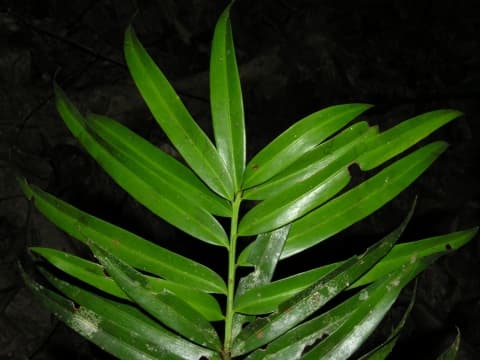
Podocarpus guatemalensis
Podocarpus guatemalensis
Safety & Hazards
None known
Cultivation Details
A tree of mainly moderate elevations in the tropics, it grows best at elevations above 600 metres[1]. Species in this genus are generally slow-growing[2]. A dioecious species, both male and female forms need to be grown if fruit and seed are required.
Propagation
The seed can be sown at any time of the year in a sandy soil, though it is probably best sown as soon as it is ripe[3]. When they are large enough to handle, prick the seedlings out into individual pots and grow them on until large enough to plant out. Cuttings of half-ripe terminal shoots, 5 - 10cm long, in a frame[4]. Cite as: Tropical Plants Database, Ken Fern. tropical.theferns.info. 2026-02-20. <tropical.theferns.info/viewtropical.php?id=Podocarpus+guatemalensis>
Pollinators
Wind
References
- [1]Present and Potential Commercial Timbers of the Caribbean — Longwood.F.R. · USDA Forest Service; Washington, DC. · 1962 ↩︎Quite detailed information on more than 60 species of Caribbean timber trees, giving species descriptions, habitat, detailed info on the wood and some info on other uses. Available for download on the internet.
- [2]IUCN Red List of Threatened Species — http://www.iucnredlist.org/ ↩︎A list of plants under threat and facing possible extinction, usually with brief details of the threats and information on habitat.
- [3]RHS Dictionary of Plants plus Supplement. 1956 — F. Chittendon. · Oxford University Press · 1951 · ISBN - ↩︎Comprehensive listing of species and how to grow them. Somewhat outdated, it has been replaced in 1992 by a new dictionary (see [ 200 ]).
- [4]Propagation of Trees, Shrubs and Conifers. — Sheat. W. G. · MacMillan and Co · 1948 · ISBN - ↩︎A bit dated but a good book on propagation techniques with specific details for a wide range of plants.
- [5]Flora of Guatemala — Standley P.C. & J. A. Steyermark · 1946 - 1976 · http://www.archive.org/ ↩︎A superb reference, though somewhat dated. Gives lots of plant uses as well as information on plant habit and habitat. The entire flora (13 volumes) can now be downloaded from http://www.archive.org/