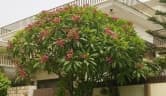
Plumeria rubra
Plumeria rubra
Safety & Hazards
The latex found in the stems of the plant is toxic but not deadly unless taken in large quantities[1].
Cultivation Details
Frangipani is a plant of hot, dry to moderate rainfall areas, at elevations up to 600 metres[2]. Plants succeed in climates with a pronounced dry season, when they are deciduous and flower on the bare branches, as well as in more humid conditions when they will remain evergreen[3]. One of the easiest of trees to grow, it is adaptable to most soil conditions though it prefers a fertile, well-drained soil in a sunny position[4, 1]. Plants are very tolerant of salt-laden winds[1, 2]. Established plants are very salt tolerant[1]. The soft, thick branches bleed profusely if broken[3]. The branches are fleshy, but brittle[5].
Propagation
Seed - Stem tip cuttings[3]. Allow to dry for several days before rooting in a cool, shaded position in a well-drained medium kept on the dry side until roots have formed[3]. Quite large limbs root easily[1]. Layering. Cite as: Tropical Plants Database, Ken Fern. tropical.theferns.info. 2026-02-20. <tropical.theferns.info/viewtropical.php?id=Plumeria+rubra>
Pollinators
Moths
References
- [1]Tropical and Subtropical Trees - A Worldwide Encyclopaedic Guide. — Barwick. M. · Thames & Hudson, London · 2004 · ISBN 0-500-51181-0 ↩︎A superb book, very concise and well written, giving a wealth of information on 400 or more species including descriptions, habitat, cultivation details and plant uses. A wealth of colour photographs bring each plant vividly to life.
- [2]Dominica Botanic Gardens — http://www.da-academy.org/trees_shrubs.html ↩︎An on-line resource, providing top quality pictures and some basic information on various plants being grown at the Botanic Gardens, often including uses and habitat.
- [3]The New RHS Dictionary of Gardening. 1992. — Huxley. A. · MacMillan Press · 1992 · ISBN 0-333-47494-5 ↩︎Excellent and very comprehensive, though it contains a number of silly mistakes. Readable yet also very detailed.
- [4]Tropical Ornamentals; A Guide — Whistler. W. Arthur. · Timber Press Inc. Oregon. · 2000 · ISBN 0-88192-448-2 ↩︎An excellent little guide to some of the more commonly cultivated ornamental plants of the Tropics, often giving some information on the plants other uses.
- [5]Medicinal Plants in Vietnam — Nguyen Van Dan & Doan Thi Nhu · World Health Organisation · 1989 · ISBN 92 9061 101 4 ↩︎An excellent book, giving information on over 200 plants, their medicinal compounds and applications.
- [6]Flora of Guatemala — Standley P.C. & J. A. Steyermark · 1946 - 1976 · http://www.archive.org/ ↩︎A superb reference, though somewhat dated. Gives lots of plant uses as well as information on plant habit and habitat. The entire flora (13 volumes) can now be downloaded from http://www.archive.org/
- [7]The Useful Plants of West Tropical Africa. — Burkil. H. M. · Royal Botanic Gardens; Kew. · 1985 - 2004 ↩︎Brief descriptions and details of the uses of over 4,000 plants. A superb, if terse, resource, it is also available electronically on the Web - see http://www.aluka.org/
- [8]Cornucopia II — Facciola. S. · Kampong Publications, California. · 1998 · ISBN 0-9628087-2-5 ↩︎The second edition of an excellent guide to the edible uses of plants, though it does not give any details of cultivation etc.
- [9]Medicinal Plants in the South Pacific — WHO Regional Publications, Manilla. · 1998 · ISBN 92-9061-118-9 ↩︎Excellent guide to 102 medicinal herbs of the Pacific Islands, with photographs of each plant and details of their constituents, biological activities and traditional uses. A description of each plant, together with habitat and distribution is given.
- [10]Plants and People of Nepal — Manandhar. N. P. · Timber Press. Oregon. · 2002 · ISBN 0-88192-527-6 ↩︎Excellent book, covering over 1,500 species of useful plants from Nepal together with information on the geography and peoples of Nepal. Good descriptions of the plants with terse notes on their uses.
- [11]Medicinal Plants of the Guianas — DeFilipps, R. A.; Maina, S. L.; & Crepin, J. · Smithsonian Museum · http://botany.si.edu/bdg/medicinal/index.html ↩︎A down-loadable PDF document of a book in pre-publication awaiting illustration. An excellent, if rather terse, guide to the traditional medicinal uses of the plants of the region
- [12]Agroforestry in the Pacific Islands: Systems for Sustainability — W.C. Clarke and R.R. Thaman (Editors) · United Nations University Press, Tokyo · 1993 · http://www.unu.edu/unupress/unupbooks/80824e/80824E00.htm#Contents · ISBN 92-808-0824-9 ↩︎The guide includes information on 100 species of plants for Agroforestry. It is also available on the web at the address given above.
- [13]Dictionary of Economic Plants. — Uphof. J. C. Th. · Weinheim · 1959 · ISBN - ↩︎An excellent and very comprehensive guide but it only gives very short descriptions of the uses without any details of how to utilize the plants. Not for the casual reader.