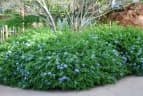
Plumbago auriculata
Plumbago auriculata
Safety & Hazards
Poultry and sheep readily eat the leaves, but poisoning has been recorded[1]. Traditionally, the plant is rubbed into scarifications in the body as a treatment for various health conditions. This treatment is not without danger - death by irritation has been recorded when the plant has been rubbed into large areas[1].
Cultivation Details
Plumbago is a native of the subtropics, in S. Africa, but is widely cultivated as an ornamental in both the subtropics and the tropics[1]. It grows best in regions with a pronounced dry season. It can withstand some frost; even if killed to the ground, it usually recovers quickly[1]. Grows best in a very sunny position, but tolerate light shade[1, 2, 3]. Tolerant of various soils, it prefers fertile, well-drained, slightly acidic, sandy soils[1, 3]. Plants are drought resistant once established[1]. The plant is salt tolerant[1]. Plumbago is fast-growing and spreas rapidly - it will scramble into trees if allowed and, depending on the size and style of your garden, you may need to control it. It is very useful in large gardens and landscapes as it forms suckers and will cover fairly big areas[4]. Plumbago auriculata flowers all year round, except if the temperature drops below 10°c. The flowers attract large numbers of butterflies[1]. There are sticky, gland tipped hairs on the flower calyx. The seed capsule retains the stickiness which presumably helps disperse the seed by attaching to animals. The top of the capsule splits opens and drops the seed out[4]. Periodic heavy pruning and bright sunlight induce prolific flowering[1].
Propagation
Seed - sow in trays in a light soil and keep the soil moist, but not wet[1]. Division of older plants[1]. Rooted suckers[1]. Semi-ripe cuttings[1]. Cite as: Tropical Plants Database, Ken Fern. tropical.theferns.info. 2026-02-20. <tropical.theferns.info/viewtropical.php?id=Plumbago+auriculata>
Pollinators
Butterflies
References
- [1]Protabase - Plant Resources of Tropical Africa. — http://www.prota.org ↩︎An excellent on-line database with detailed information on over 3,200 species of useful plants of Africa.
- [2]KemperCentreForHomeGardeningPlantFinder — Missouri Botanical Garden · http://www.mobot.org/gardeninghelp/plantfinder/ ↩︎Basic cultivation details, plant uses, habitat etc for several thousand species of plants, mainly from the temperate zone.
- [3]Desert Tropicals — http://www.desert-tropicals.com/ ↩︎The main focus of the site is succulent plants, but it also contains information on a wide range of other species. Usually at least one good photograph, plus basic information about the plant and its cultivation.
- [4]PlantZAfrica.com — http://www.plantzafrica.com ↩︎An excellent site giving detailed descriptions and uses of many S. African plants.