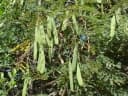
Fabaceae FAMILY
Plathymenia reticulata
Plathymenia reticulata
Edibility
0/5
Medicinal
0/5
Safety & Hazards
None known
Cultivation Details
HabitDeciduous Tree
Growth—
Prefers a sunny position, succeeding in poor soils[1]. Prefers a well-drained soil[1]. Young plants can be slow to establish and develop[1].
Propagation
Seed - fresh seed, sown immediately, does not require pre-treatment, although scarification might increase germination rates[1]. Sow in semi-shade in a nursery bed, covering the seed with a thin layer of soil[1]. Germination rates are normally low, with less than 20% germinating in 10 - 30 days[1]. Seedlings grow away slowly, but are ready to plant out after 8 - 10 months[1]. Cite as: Tropical Plants Database, Ken Fern. tropical.theferns.info. 2026-02-20. <tropical.theferns.info/viewtropical.php?id=Plathymenia+reticulata>
Pollinators
Data unavailable
References
- [1]Brazilian Trees. Volume 1. 4th Edition. — Lorenzi. H. · Instituto Plantarum De Estudos Da Flora; Brazil. · 2002 · ISBN 85-86714-17-8 ↩︎Information on 350 species of Brazilian trees. Stunning photographs of each species, brief details on the plant, its uses and how to grow it from seed. A superb work, with the minor irritation that the translation from Portuguese is not of the best.
- [2]South American Timbers: the Properties, Uses and Characteristics of 190 Species. — Bolza. E. & Christensen. F.J. · Commonwealth Scientific and Industrial Research Organization · 1979 · ISBN 0 643 02582 0 ↩︎A very useful guide.
- [3]Dictionary of Economic Plants. — Uphof. J. C. Th. · Weinheim · 1959 · ISBN - ↩︎An excellent and very comprehensive guide but it only gives very short descriptions of the uses without any details of how to utilize the plants. Not for the casual reader.
- [4]Water extracts of Brazilian leguminous seeds as rich sources of larvicidal compounds against Aedes aegypti L. — Davi F. Farias et al · 2010 · ISBN 0001-3765 ↩︎