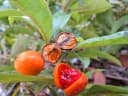
Cultivation Details
Pittosporum species generally grow best in a sunny position, but tolerate light shade. They succeed in most well-drained soils[3, 4]. Although flowers usually appear to be hermaphrodite, many species of Pittosporum are functionally dioecious, with individual specimens bearing mainly or totally flowers of one sex only. Even so, occasional functionally hermaphrodite flowers will appear and, in at least some species, these flowers can be self-compatible and produce fertile seed even in the absence of any other plants of that species[5]. The species in this genus are also very likely to hybridize with other members of the genus[4]. When growing a species from seed it is important to ensure that the seed either comes from a known wild source, or from isolated specimens in cultivation.
Propagation
Seed - best sown as soon as it is ripe. Cuttings of half-ripe wood, 5 - 7cm with a heel[6]. Basal ripewood cuttings in a cold frame[4]. Cite as: Tropical Plants Database, Ken Fern. tropical.theferns.info. 2026-02-20. <tropical.theferns.info/viewtropical.php?id=Pittosporum+ferrugineum>
Pollinators
Insects
References
- [1]Flora Malesiana Series 1 — Various · Nationaal Herbarium Nederiand, Universiteit Leiden branch · http://www.archive.org ↩︎A massive treatment of the plants of the Malaysian Archipelago. Much of it has been made available to download from the Internet
- [2]Tree Flora of Sabah and Sarawak Vols 1 - 6 — Soepadmo E.; Saw L.G.; Chung R.C.K. (Editors) · Forest Research Institute Malaysia; Kuala Lumpur. · 2002 · ISBN 983-2181-27-5 ↩︎A flora of the woody plants of Sabah and Sarawak on the island of Borneo, often giving details of plant uses.
- [3]Ornamental Shrubs, Climbers and Bamboos. — Thomas. G. S. · Murray · 1992 · ISBN 0-7195-5043-2 ↩︎Contains a wide range of plants with a brief description, mainly of their ornamental value but also usually of cultivation details and varieties.
- [4]The New RHS Dictionary of Gardening. 1992. — Huxley. A. · MacMillan Press · 1992 · ISBN 0-333-47494-5 ↩︎Excellent and very comprehensive, though it contains a number of silly mistakes. Readable yet also very detailed.
- [5]Revision of Pittosporum (Pittosporaceae) in Australia — Cayzer L.W.; Crisp M.D. & Telford I.R.H. · 2000 ↩︎A comprehensive review of the genus in Australia
- [6]Propagation of Trees, Shrubs and Conifers. — Sheat. W. G. · MacMillan and Co · 1948 · ISBN - ↩︎A bit dated but a good book on propagation techniques with specific details for a wide range of plants.
- [7]Australian Tropical Rainforest Plants — http://www.anbg.gov.au/cpbr/cd-keys/rfk/index.html ↩︎An online resource giving botanical information, and a little bit about plant usage, for over 2,700 species of plants found in the Australian rainforest.
- [8]Medicinal Plants in Papua New Guinea — World Health Organisation · 2009 · ISBN 978-92-9061-249-0 ↩︎Traditional medicinal uses of 126 species from Papua New Guinea, including information on modern research into the plants.
- [9]The Australian and New Zealand Species of Pittosporum — Cooper R.C. · 1956 ↩︎Rather dated, but still an excellent treatment.