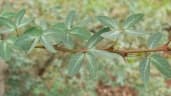
Pithecellobium dulce
Pithecellobium dulce
Safety & Hazards
The bark contains irritating substances, which can cause eye infections[1].
Cultivation Details
The tree grows well at low and medium altitudes in both wet and dry areas of the tropics[1]. It can tolerate an annual rainfall as low as 140mm and as high as 2,200mm[2]. It will grow in areas where the average temperature ranges from 18 - 27.9°c[2]. An easily grown plant that can succeed in most soils, it prefers a well-drained soil in a sunny position[3]. Can also succeed in heavy clay soils[1]. The tree can grow on poor soils, on wastelands and even with its roots in brackish water[2]. Established plants are drought tolerant[3, 4]. Tolerates a pH as high as 8.3[2]. Plants have escaped from cultivation and become naturalized as a weed in dry places in some areas of the tropics[3]. Commences flowering when only 1 - 2 metres tall[4]. Trees can reach a height of 12 - 15 metres in about 40 years. In favourable soil conditions, they may reach a height of 10 metres in only 5 - 6 years[2]. The trees coppice vigorously and produce root suckers upon injury to the roots[2]. Once planted in the field, the tree does not need any treatment other than occasional pruning[2]. There are some named varieties[5]. This species has a symbiotic relationship with certain soil bacteria, these bacteria form nodules on the roots and fix atmospheric nitrogen. Some of this nitrogen is utilized by the growing plant but some can also be used by other plants growing nearby[6].
Propagation
Seed - takes about 2 weeks to germinate[2]. No pre-treatment is required - soaking actually reduces germination and heating kills the seeds[2]. Best sown into nursery beds and planted out when about 12 months old[2]. Plants often self-seed, especially around the margins of cultivated fields where plentiful seeding can be found under mature trees[2]. Cuttings. Air layerng. Grafting. Cite as: Tropical Plants Database, Ken Fern. tropical.theferns.info. 2026-02-20. <tropical.theferns.info/viewtropical.php?id=Pithecellobium+dulce>
Pollinators
Bees
References
- [1]Under-Utilized Tropical Fruits of Thailand. RAP — Suranant Subhadrabandhu · F. A. O., The United Nations, Bangkok. · 2001 · http://www.fao.org/3/a-ab777e.pdf ↩︎A detailed report on 35 fruit species that could have potential for increased production in Thailand. The report can be downloadd as a PDF from the internet.
- [2]World Agroforesty Centre — http://www.worldagroforestry.org/ ↩︎An excellent online database of a huge range of trees giving very good information on each plant - its uses, ecology, identity, propagation, pests etc.
- [3]Tropical Ornamentals; A Guide — Whistler. W. Arthur. · Timber Press Inc. Oregon. · 2000 · ISBN 0-88192-448-2 ↩︎An excellent little guide to some of the more commonly cultivated ornamental plants of the Tropics, often giving some information on the plants other uses.
- [4]Flora of Guatemala — Standley P.C. & J. A. Steyermark · 1946 - 1976 · http://www.archive.org/ ↩︎A superb reference, though somewhat dated. Gives lots of plant uses as well as information on plant habit and habitat. The entire flora (13 volumes) can now be downloaded from http://www.archive.org/
- [5]Cornucopia II — Facciola. S. · Kampong Publications, California. · 1998 · ISBN 0-9628087-2-5 ↩︎The second edition of an excellent guide to the edible uses of plants, though it does not give any details of cultivation etc.
- [6]Nodulation Plants in GRIN Taxonomy — United States Department of Agriculture · http://www.ars-grin.gov/~sbmljw/cgi-bin/taxnodul.pl?language=en ↩︎An online database listing plants that have either positive or negative reports on root and stem nodulation with nitrogen-fixing bacteria.
- [7]Digital Compendium of Forestry Species of Cambodia — www.digitalspecies.blogspot.com; Phnom Penh · 2008 · http://www.digitalspecies.blogspot.com ↩︎A very detailed booklet, produced in PDF format on the internet, giving information on around 100 species of trees.
- [8]Dictionary of Economic Plants. — Uphof. J. C. Th. · Weinheim · 1959 · ISBN - ↩︎An excellent and very comprehensive guide but it only gives very short descriptions of the uses without any details of how to utilize the plants. Not for the casual reader.
- [9]Rio Mayo Plants - A study of the flora and vegetation of the valley of the Rio Mayo, Sonora — Gentry H.S. · Carnegie Institution of Washington; Washington DC · 1942 ↩︎One of my favourite authors on native plants, often including their uses. This is an excellent example with lots of information, even though the book is 80 years old.
- [10]The New RHS Dictionary of Gardening. 1992. — Huxley. A. · MacMillan Press · 1992 · ISBN 0-333-47494-5 ↩︎Excellent and very comprehensive, though it contains a number of silly mistakes. Readable yet also very detailed.
- [11]Plants and People of Nepal — Manandhar. N. P. · Timber Press. Oregon. · 2002 · ISBN 0-88192-527-6 ↩︎Excellent book, covering over 1,500 species of useful plants from Nepal together with information on the geography and peoples of Nepal. Good descriptions of the plants with terse notes on their uses.