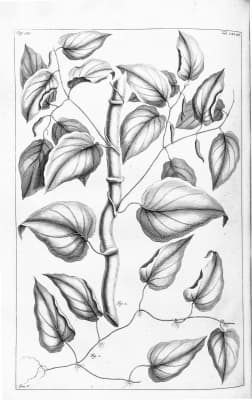
Piper caducibracteum
Piper caducibracteum
Safety & Hazards
None known
Cultivation Details
Scrambling plants form new roots where their leaf axils touch the ground[PFAF]. A dioecious species - both male and female forms need to be grown if fruit and seed are required.
Propagation
Seed - Cuttings 30 - 45cm long, taken from the tips of vertical shoots[1]. Cuttings usually have 3 - 5 nodes and are planted with the lowest 2 nodes buried in the soil. The cuttings are planted in nurseries or, more commonly, directly in the field, where they are planted close together in pits or long mounds. When the cuttings begin to sprout and creep along, they are tied to the support[1] Cite as: Tropical Plants Database, Ken Fern. tropical.theferns.info. 2026-02-20. <tropical.theferns.info/viewtropical.php?id=Piper+caducibracteum>
Pollinators
Data unavailable
References
- [1]Plant Resources of Southeast Asia — http://proseanet.org/ ↩︎Lots of information on the uses of the plants of SE Asia.
- [2]Dictionary of Economic Plants. — Uphof. J. C. Th. · Weinheim · 1959 · ISBN - ↩︎An excellent and very comprehensive guide but it only gives very short descriptions of the uses without any details of how to utilize the plants. Not for the casual reader.
- [3]The Encyclopedia of Medicinal Plants — Chevallier. A. · Dorling Kindersley. London · 1996 · ISBN 9-780751-303148 ↩︎An excellent guide to over 500 of the more well known medicinal herbs from around the world.
- [PFAF]Plants for a Future — pfaf.org ↩︎