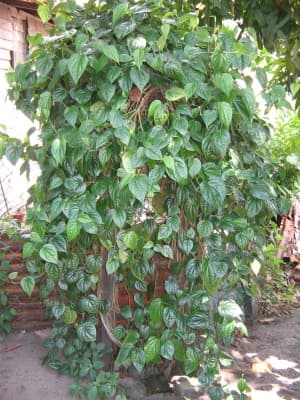
Piper betle
Piper betle
Safety & Hazards
Chewing betel quids can lead to cancers in the mouth and on the tongue[1].
Cultivation Details
Betel pepper is a plant of lowland tropical areas , usually at elevations below 900 metres[2]. It prefers growing in areas where the mean annual temperature falls within the range 22 - 27°c, but can tolerate 17 - 31°c[3]. It thrives under per-humid forest conditions with high relative humidity and ample supply of soil moisture. It flourishes in areas with a mean annual rainfall in the range 2,250 - 4,750mm[2]. Prefers a position in shade and also needs protection from the wind[2]. It prefers a deep, well-drained, friable loamy and clayey soil, rich in organic matter and with a pH of about 7 - 7.5[2]. Prefers a pH in the range 5 - 5.6, but tolerates 4.3 - 6.8[3]. Young plants grow quickly and, under favourable conditions, can commence being harvested when only 18 months old[2]. Grown under favourable conditions, they usually have larger and less pungent leaves[2]. Each vine is picked 3 - 4 (occasionally 5) times a year[2]. Leaves are traditionally plucked early in the morning by cutting the petiole with a sharpened steel thumbnail. They should be kept out of the sun to preserve their aroma. Other factors determining chewing quality are cultivar, leaf position and plant age. The best leaves are large, yellow and grow on the upper lateral branches. In Malaysia leaves on the lower lateral branches are regarded as medicinal and are used in preparations applied on ulcers and wounds[2]. Annual yields are estimated at 6 - 10 tonnes per hectare, each vine yields 40 - 50 leaves per year[2]. When a vine becomes 2 metres long, it produces smaller and poorer quality leaves, so must be rejuvenated by cutting back[2]. Regular rejuvenation is achieved by taking the vines off their supports and burying the lower part in the soil. New roots form and the vigorous new sprouts are trained along supports[2]. The life of a plantation may vary considerably: from 3 - 4 years in temporary gardens to 30 - 50 years in permanent ones[2]. Although only known from cultivation, betel pepper is a very variable species[2]. Numerous cultivars exist with leaves differing in size, shape and colour, and in softness, pungency, aroma and bleaching response[2]. In Indonesia and Malaysia some cultivars have a clove-like flavour. In India 5 cultivars are known, differing in morphology and essential-oil composition[2]. Closely related species, which are also only known from cultivation, are Piper siriboa and Piper chuvya[2]. Betel pepper needs support for its growth, which may be provided by trees, bamboo, wooden poles or concrete pillars[2]. A dioecious species - both male and female forms need to be grown if fruit and seed are required.
Propagation
Seed - Cuttings 30 - 45cm long, taken from the tips of vertical shoots[2]. Cuttings usually have 3 - 5 nodes and are planted with the lowest 2 nodes buried in the soil. The cuttings are planted in nurseries or, more commonly, directly in the field, where they are planted close together in pits or long mounds. When the cuttings begin to sprout and creep along, they are tied to the support[2] Cite as: Tropical Plants Database, Ken Fern. tropical.theferns.info. 2026-02-20. <tropical.theferns.info/viewtropical.php?id=Piper+betle>
Pollinators
Data unavailable
References
- [1]The Encyclopedia of Medicinal Plants — Chevallier. A. · Dorling Kindersley. London · 1996 · ISBN 9-780751-303148 ↩︎An excellent guide to over 500 of the more well known medicinal herbs from around the world.
- [2]Plant Resources of Southeast Asia — http://proseanet.org/ ↩︎Lots of information on the uses of the plants of SE Asia.
- [3]Ecocrop — http://ecocrop.fao.org/ecocrop/srv/en/home ↩︎Basic information on a wide range of useful plants, plus details of environmental needs where available.
- [4]Medicinal Plants in Vietnam — Nguyen Van Dan & Doan Thi Nhu · World Health Organisation · 1989 · ISBN 92 9061 101 4 ↩︎An excellent book, giving information on over 200 plants, their medicinal compounds and applications.