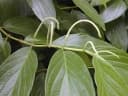
Piper aduncum
Piper aduncum
Safety & Hazards
None known
Cultivation Details
A plant of tropical regions, found mainly at lower elevations up to 1,000 metres, but extending to over 2,000 metres in places. It grows best in areas with a mean annual rainfall from 1.500 - 4,000mm or more[1]. The plant is moderately intolerant of shade, as it requires at least partial exposure to sunlight for it to reach a large size and flower[1]. It colonizes most soil types, apart from excessively well-drained soils (where it only grows at the upper end of the rainfall range); dry soils; and salty soils[1]. An invader of disturbed areas, where it is able to form thickets and spread by sprouts and suckers[1]. The plant has spread through cultivation and has become naturalized in many areas including southeast Asia, the Pacific and north America. It has been declared a noxious weed in parts of N. America and is a problem in some Pacific Islands, where it can interfere with the harvesting of the related kava plant[1]. It requires high light levels and a bare soil surface, which means that disturbance is necessary for this species to establish[1]. The tree produces cord-like, white to pale yellow, inflorescence spikes that contain many minute flowers that are wind-pollinated and that soon develop into numerous tiny drupes with black seeds. The seeds are then scattered easily by bats and birds[2]. From these many seeds, it can form large stands of quickly-growing shrubby trees that can choke out other native vegetation[2]. Established plants also thicken into clumps or stands by suckers arising from the root crown[2]. The plant can flower and produce fruit all year round[3]. The fruits, leaves and seeds have a peppery taste and aroma[3].
Propagation
Seed - Cuttings Suckers. Cite as: Tropical Plants Database, Ken Fern. tropical.theferns.info. 2026-02-20. <tropical.theferns.info/viewtropical.php?id=Piper+aduncum>
Pollinators
Data unavailable
References
- [1]Global Invasive Species Database — http://www.issg.org/database/welcome/ ↩︎Very detailed information on almost 400 species (with more being added) of plants that have become weeds in areas outside their native range.
- [2]Raintree Nutrition - Tropical Plant Database — http://www.rain-tree.com/plants.htm ↩︎Detailed information on the medicinal uses of more than two hundred rainforest plants, mainly from S. America, with basic descriptions of the plants, their other uses etc.
- [3]Common Trees of Puerto Rico and the Virgin Islands — Little E.L.; Wadsworth F.H. · USDA, Forest Service; Washington. · 1964 ↩︎Contains detailed information, and usually an illustration, on 250 tree species, including both native and exotic species.
- [4]Trees of Sungai Wain — http://www.nationaalherbarium.nl/Sungaiwain/ ↩︎An excellent site with factsheets on almost 1,000 species of forest trees growing at Sungai Wain in Indonesia. Each factsheet has good quality pictures plus basic information on the ecology and uses of the plants.
- [5]Plant Resources of Southeast Asia — http://proseanet.org/ ↩︎Lots of information on the uses of the plants of SE Asia.
- [6]Mansfeld's Database of Agricultural and Horticultural Plants — http://mansfeld.ipk-gatersleben.de/pls/htmldb_pgrc/f?p=185:3:4292127278597336 ↩︎Terse details of a huge range of useful plants.
- [7]Cornucopia II — Facciola. S. · Kampong Publications, California. · 1998 · ISBN 0-9628087-2-5 ↩︎The second edition of an excellent guide to the edible uses of plants, though it does not give any details of cultivation etc.
- [8]Dictionary of Economic Plants. — Uphof. J. C. Th. · Weinheim · 1959 · ISBN - ↩︎An excellent and very comprehensive guide but it only gives very short descriptions of the uses without any details of how to utilize the plants. Not for the casual reader.