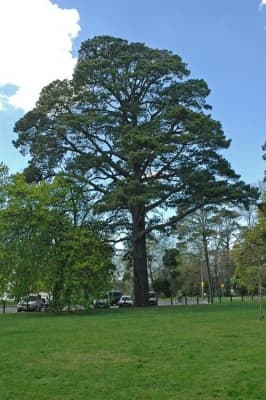
Pinus radiata
Pinus radiata
Safety & Hazards
The wood, sawdust and resins from various species of pine can cause dermatitis in sensitive people[1].
Cultivation Details
Monterey pine is a plant of the semi-arid, warm temperate zone of coastal southern California and is extensively cultivated in warm temperte zones and in tropical areas above 1,200 metres. In its native range the cold ocean water moving down the Californian coast substantially influences the local climate, raising humidity, tempering heat from the sun and causing almost daily summer fogs. On a rare clear day in summer temperatures can quickly rise to 40°c, coming down to only 15°c on the next foggy day[2]. Rain fall is erratic, fog drip providing most of the moisture to the soil and the trees[2]. In cultivation, the plant grows best in areas where annual daytime temperatures are within the range 18 - 30°c, but can tolerate 7 - 40°c[3]. When dormant,it can survive temperatures down to about -15°c, but young growth can be severely damaged at -1°c[3]. Trees are somewhat frost-tender when young[4]. It prefers a mean annual rainfall in the range 650 - 1,200mm, but tolerates 330 - 1,600mm[3]. It can grow with a dry season of up to 6 months[5]. Grows best in a sunny position[3]. Thrives in a light well-drained sandy or gravelly loam[6, 4]. It grows best on deep, well-drained, neutral to acid soils[5]. Dislikes poorly drained moorland soils[6]. Prefers a pH in the range 5.5 - 6.5, but can tolerate 4.5 - 7.5[3]. Established plants tolerate drought[7]. Very resistant to maritime exposure[8], the leaves can be badly burned by cold dry winds but this does not seem to affect growth[4]. Mature trees produce a broad heavy crown and are somewhat likely to be blown down in severe gales[7]. The plant tolerates relatively high levels of air pollution[2]. A fast-growing tree[3]. Growth can be exceptionally fast, after an initial phase of 2 - 5 years, plants have a growth rate of up to 2 metres a year[5]. Pollen production starts when trees are 5 - 6 years old, and female flowering starts around the same age. Female cones take 2 years to mature. Mature cones are 8 - 17cm long, they may remain closed on the tree for up to 40 years, only opening after the heat of a forest fire followed by rain[9, 7, 5]. A short-lived tree in the wild, where it rarely lives longer than 100 years[10]. It grows larger in cultivation than it does in the wild[7]. Plants are strongly outbreeding, self-fertilized seed usually grows poorly[7]. They hybridize freely with other members of this genus[7]. Plants can produce new shoots from reasonably old wood so the lower branches can be cut back to produce a hedge-like effect[4]. Plants in this genus are notably susceptible to honey fungus[7].
Propagation
It is best to sow the seed in individual pots in a cold frame as soon as it is ripe if this is possible otherwise in late winter. A short stratification of 6 weeks at 4°c can improve the germination of stored seed[11]. Plant seedlings out into their permanent positions as soon as possible and protect them for their first winter or two[4]. Plants have a very sparse root system and the sooner they are planted into their permanent positions the better they will grow[PFAF]. Trees should be planted into their permanent positions when they are quite small, between 30 and 90cm[7]. We actually plant them out when they are about 5 - 10cm tall. So long as they are given a very good weed-excluding mulch they establish very well[PFAF]. Larger trees will check badly and hardly put on any growth for several years. This also badly affects root development and wind resistance[7]. Cuttings. This method only works when taken from very young trees less than 10 years old. Use single leaf fascicles with the base of the short shoot. Disbudding the shoots some weeks before taking the cuttings can help. Cuttings are normally slow to grow away[10]. Cite as: Temperate Plants Database, Ken Fern. temperate.theferns.info. 2026-02-21. <temperate.theferns.info/plant/Pinus+radiata>
Pollinators
Wind
References
- [1]A Field Guide to Medicinal Plants. Eastern and Central N. America. — Foster. S. & Duke. J. A. · Houghton Mifflin Co. · 1990 · ISBN 0395467225 ↩︎A concise book dealing with almost 500 species. A line drawing of each plant is included plus colour photographs of about 100 species. Very good as a field guide, it only gives brief details about the plants medicinal properties.
- [2]IUCN Red List of Threatened Species — http://www.iucnredlist.org/ ↩︎A list of plants under threat and facing possible extinction, usually with brief details of the threats and information on habitat.
- [3]Ecocrop — http://ecocrop.fao.org/ecocrop/srv/en/home ↩︎Basic information on a wide range of useful plants, plus details of environmental needs where available.
- [4]Trees and Shrubs Hardy in Great Britain. Vol 1 - 4 and Supplement. — Bean. W. · Murray · 1981 · ISBN - ↩︎A classic with a wealth of information on the plants, but poor on pictures.
- [5]Protabase - Plant Resources of Tropical Africa. — http://www.prota.org ↩︎An excellent on-line database with detailed information on over 3,200 species of useful plants of Africa.
- [6]RHS Dictionary of Plants plus Supplement. 1956 — F. Chittendon. · Oxford University Press · 1951 · ISBN - ↩︎Comprehensive listing of species and how to grow them. Somewhat outdated, it has been replaced in 1992 by a new dictionary (see [ 200 ]).
- [7]The New RHS Dictionary of Gardening. 1992. — Huxley. A. · MacMillan Press · 1992 · ISBN 0-333-47494-5 ↩︎Excellent and very comprehensive, though it contains a number of silly mistakes. Readable yet also very detailed.
- [8]Shelter Trees and Hedges. — Rosewarne experimental horticultural station. · Ministry of Agriculture, Fisheries and Food · 1984 · ISBN - ↩︎A small booklet packed with information on trees and shrubs for hedging and shelterbelts in exposed maritime areas.
- [9]Manual of the Trees of N. America. — Sargent. C. S. · Dover Publications Inc. New York. · 1965 · http://www.biodiversitylibrary.org/ · ISBN 0-486-20278-X ↩︎Two volumes, a comprehensive listing of N. American trees though a bit out of date now. Good details on habitats, some details on plant uses. Not really for the casual reader. It can be downloaded from the internet.
- [10]Conifers. — Rushforth. K. · Christopher Helm · 1987 · ISBN 0-7470-2801-X ↩︎Deals with conifers that can be grown outdoors in Britain. Good notes on cultivation and a few bits about plant uses.
- [11]Hardy Woody Plants from Seed. — McMillan-Browse. P. · Grower Books · 1985 · ISBN 0-901361-21-6 ↩︎Does not deal with many species but it is very comprehensive on those that it does cover. Not for casual reading.
- [12]Invasive Species Compendium — http://www.cabi.org ↩︎An immense resource - in depth information on over 900 species of invasive plants (it also has information on animals, fungi etc).
- [13]A California Flora. — Munz P.A. & Keck D.D. · University of California Press; Los Angeles · 1959 · ISBN - ↩︎An excellent flora but no pictures. Not for the casual reader.
- [14]The Gymnosperm Database — http://www.conifers.org/index.htm ↩︎A vast amount of information on conifers and families of gymnosperms.
- [15]A Modern Herbal. — Grieve. · Penguin · 1984 · ISBN 0-14-046-440-9 ↩︎Not so modern (1930's?) but lots of information, mainly temperate plants.
- [16]Nature's Colors - Dyes from Plants. — Grae. I. · MacMillan Publishing Co. New York. · 1974 · ISBN 0-02-544950-8 ↩︎A very good and readable book on dyeing.
- [17]CosIng — http://ec.europa.eu/growth/tools-databases/cosing/ ↩︎CosIng is the European Commission database for information on cosmetic substances and ingredients.
- [18]Vegetable Gums and Resins. — Howes. F. N. · Faber · ISBN 81-88818-17-8 ↩︎A very good book dealing with the subject in a readable way.
- [PFAF]Plants for a Future — pfaf.org ↩︎