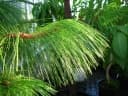
Pinus montezumae
Pinus montezumae
Safety & Hazards
The wood, sawdust and resins from various species of pine can cause dermatitis in sensitive people[1].
Cultivation Details
Pinus montezumae is a tree of higher elevations in the tropics, it is also grown in the subtropics and warm temperate areas. It is found in the tropics at elevations from 2,000 (rarely less) to 3,200 metres[2]. It grows best in areas where annual daytime temperatures are within the range 16 - 24°c, but can tolerate 8 - 28°c[3]. When dormant, the plant can survive for short periods with temperatures down to about -5°c, but young growth can be severely damaged at -1°c[4, 2, 3]. It prefers a mean annual rainfall in the range 1,200 - 1,400mm, but tolerates 900 - 1,600mm[3]. Snow, sleet and frosts occur during the cold season at the higher elevations, especially in the north of its range in its range[2]. Pine species in general require a sunny position if they are to grow well and, whilst the different species have their own soil preferences, most will thrive in a light well-drained sandy or gravelly loam[5, 6]. Young plants are quite shade tolerant, but become more light-demanding as they grow older[3]. Dislikes poorly drained moorland soils[5]. Prefers a pH in the range 5.5 - 6.5, tolerating 4.5 - 8[3]. Established plants tolerate drought[4]. A very variable tree[7]. A very vigorous tree, especially in girth, for its first 60 years but then rapidly declining in vigour and not usually living much longer[7]. The cones open and shed their seed whilst still attached to the tree[8]. Plants are strongly outbreeding, self-fertilized seed usually grows poorly[4]. They hybridize freely with other members of this genus[4]. This is one of several Pinus species that have a juvenile life stage. After germinating, the seedlings produce secondary foliage but the central shoot does not elongate - at this stage the plant looks more like a bunchgrass than a pine. Especially when growing in shade, the plant can remain in this juvenile stage for several years, developing a large taproot but not increasing in height. If the light levels increase (due to removal of tree cover by fire, deforestation or some other reason) then the plant commences rapid height growth[2]. Plants in this genus are notably susceptible to honey fungus[4].
Propagation
It is best to sow the seed in individual pots in a cold frame as soon as it is ripe if this is possible otherwise in late winter. A short stratification of 6 weeks at 4°c can improve the germination of stored seed[9]. Plant seedlings out into their permanent positions as soon as possible and protect them for their first winter or two[6]. Plants have a very sparse root system and the sooner they are planted into their permanent positions the better they will grow[PFAF]. Trees should be planted into their permanent positions when they are quite small, between 30 and 90cm[4]. We actually plant them out when they are about 5 - 10cm tall. So long as they are given a very good weed-excluding mulch they establish very well[PFAF]. Larger trees will check badly and hardly put on any growth for several years. This also badly affects root development and wind resistance[4]. Cuttings. This method only works when taken from very young trees less than 10 years old. Use single leaf fascicles with the base of the short shoot. Disbudding the shoots some weeks before taking the cuttings can help. Cuttings are normally slow to grow away[10]. Cite as: Temperate Plants Database, Ken Fern. temperate.theferns.info. 2026-02-21. <temperate.theferns.info/plant/Pinus+montezumae>
Pollinators
Wind
References
- [1]A Field Guide to Medicinal Plants. Eastern and Central N. America. — Foster. S. & Duke. J. A. · Houghton Mifflin Co. · 1990 · ISBN 0395467225 ↩︎A concise book dealing with almost 500 species. A line drawing of each plant is included plus colour photographs of about 100 species. Very good as a field guide, it only gives brief details about the plants medicinal properties.
- [2]The Gymnosperm Database — http://www.conifers.org/index.htm ↩︎A vast amount of information on conifers and families of gymnosperms.
- [3]Ecocrop — http://ecocrop.fao.org/ecocrop/srv/en/home ↩︎Basic information on a wide range of useful plants, plus details of environmental needs where available.
- [4]The New RHS Dictionary of Gardening. 1992. — Huxley. A. · MacMillan Press · 1992 · ISBN 0-333-47494-5 ↩︎Excellent and very comprehensive, though it contains a number of silly mistakes. Readable yet also very detailed.
- [5]RHS Dictionary of Plants plus Supplement. 1956 — F. Chittendon. · Oxford University Press · 1951 · ISBN - ↩︎Comprehensive listing of species and how to grow them. Somewhat outdated, it has been replaced in 1992 by a new dictionary (see [ 200 ]).
- [6]Trees and Shrubs Hardy in Great Britain. Vol 1 - 4 and Supplement. — Bean. W. · Murray · 1981 · ISBN - ↩︎A classic with a wealth of information on the plants, but poor on pictures.
- [7]Conifers in the British Isles. — Mitchell. A. F. · HMSO · 1975 · ISBN 0-11-710012-9 ↩︎A bit out of date (first published in 1972), but an excellent guide to how well the various species of conifers grow in Britain giving locations of trees.
- [8]Identification Guide to the Trees of Canada — Lauriault. J. · Fitzhenry and Whiteside, Ontario. · 1989 · ISBN 0889025649 ↩︎Very good on identification for non-experts, the book also has a lot of information on plant uses.
- [9]Hardy Woody Plants from Seed. — McMillan-Browse. P. · Grower Books · 1985 · ISBN 0-901361-21-6 ↩︎Does not deal with many species but it is very comprehensive on those that it does cover. Not for casual reading.
- [10]Conifers. — Rushforth. K. · Christopher Helm · 1987 · ISBN 0-7470-2801-X ↩︎Deals with conifers that can be grown outdoors in Britain. Good notes on cultivation and a few bits about plant uses.
- [11]IUCN Red List of Threatened Species — http://www.iucnredlist.org/ ↩︎A list of plants under threat and facing possible extinction, usually with brief details of the threats and information on habitat.
- [12]Meet Flora Mexicana. — Pesman. M. W. · Dale S. King. Arizona. · 1962 · ISBN - ↩︎Very readable flora but rather lacking botanically. A few notes on useful plants.
- [13]A Modern Herbal. — Grieve. · Penguin · 1984 · ISBN 0-14-046-440-9 ↩︎Not so modern (1930's?) but lots of information, mainly temperate plants.
- [14]Biblioteca Digital de la Medicina Tradicional Mexicana — http://www.medicinatradicionalmexicana.unam.mx/index.php ↩︎A very valuable on-line resource with detailed information on many hundreds of medicinal plants used in Mexico
- [15]Nature's Colors - Dyes from Plants. — Grae. I. · MacMillan Publishing Co. New York. · 1974 · ISBN 0-02-544950-8 ↩︎A very good and readable book on dyeing.
- [16]Vegetable Gums and Resins. — Howes. F. N. · Faber · ISBN 81-88818-17-8 ↩︎A very good book dealing with the subject in a readable way.
- [PFAF]Plants for a Future — pfaf.org ↩︎