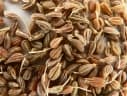
Pimpinella anisum
Pimpinella anisum
Safety & Hazards
None known
Cultivation Details
Aniseed can be grown from the temperate zone to the tropics so long as there is a growing season of at least 5 - 6 months[1]. It does not do very well at low elevations in the tropics[1]. It grows best in areas where annual daytime temperatures are within the range 18 - 26°c, but can tolerate 5 - 30°c[1]. The plant can survive temperatures down to about -7°c[1]. It prefers a mean annual rainfall in the range 900 - 1,300mm, but tolerates 600 - 1,700mm[1]. Succeeds in ordinary garden soil[2] but prefers a fairly rich warm well-drained light soil in a sunny position[2, 3, 4, 5]. Prefers a pH in the range 6.5 - 7, tolerating 6 - 7.3[1]. An optimum yield of seed is 1.5 tonnes per hectare[1]. Plants strongly resent root disturbance and should not be transplanted. A good companion plant in the garden, its aromatic nature helping to keep nearby plants free of aphis etc. Its flowers attract parasitic wasps to the garden and these prey on a large number of garden pests[6]. Aniseed grows especially well with coriander[7, 8, 9].
Propagation
Seed - sow mid to late spring in situ. This sowing only succeeds in producing a crop of ripe seeds in years when the summers are hot[6]. A more certain crop (but much more labour intensive) can be obtained by sowing 4 - 5 seeds per pot in a greenhouse in early spring. They should germinate within 3 weeks. Thin if necessary to the best seedling and plant them out after the last expected frosts[PFAF]. Aniseed strongly resents root disturbance. Cite as: Temperate Plants Database, Ken Fern. temperate.theferns.info. 2026-02-21. <temperate.theferns.info/plant/Pimpinella+anisum>
Pollinators
Insects
References
- [1]Ecocrop — http://ecocrop.fao.org/ecocrop/srv/en/home ↩︎Basic information on a wide range of useful plants, plus details of environmental needs where available.
- [2]RHS Dictionary of Plants plus Supplement. 1956 — F. Chittendon. · Oxford University Press · 1951 · ISBN - ↩︎Comprehensive listing of species and how to grow them. Somewhat outdated, it has been replaced in 1992 by a new dictionary (see [ 200 ]).
- [3]The Vegetable Garden. — Vilmorin. A. · Ten Speed Press · ISBN 0-89815-041-8 ↩︎A reprint of a nineteenth century classic, giving details of vegetable varieties. Not really that informative though.
- [4]The Gardener's Assistant. — Thompson. B. · Blackie and Son. · 1878 · ISBN - ↩︎Excellent general but extensive guide to gardening practices in the 19th century. A very good section on fruits and vegetables with many little known species.
- [5]Salads all the Year Round. — Larkcom. J. · Hamlyn · 1980 ↩︎A good and comprehensive guide to temperate salad plants, with full organic details of cultivation.
- [6]Encyclopaedia of Herbs and their Uses. — Bown. D. · Dorling Kindersley, London. · 1995 · ISBN 0-7513-020-31 ↩︎A very well presented and informative book on herbs from around the globe. Plenty in it for both the casual reader and the serious student. Just one main quibble is the silly way of having two separate entries for each plant.
- [7]Companion Plants. — Philbrick H. and Gregg R. B. · Watkins · 1979 · ISBN - ↩︎Details of beneficial and antagonistic relationships between neighbouring plants.
- [8]Companion Planting for Successful Gardening. — Riotte. L. · Garden Way, Vermont, USA. · 1978 · ISBN 0-88266-064-0 ↩︎Fairly good.
- [9]A - Z of Companion Planting. — Allardice.P. · Cassell Publishers Ltd. · 1993 · ISBN 0-304-34324-2 ↩︎A well produced and very readable book.
- [10]Dictionary of Economic Plants. — Uphof. J. C. Th. · Weinheim · 1959 · ISBN - ↩︎An excellent and very comprehensive guide but it only gives very short descriptions of the uses without any details of how to utilize the plants. Not for the casual reader.
- [11]Herbs — Phillips. R. & Foy. N. · Pan Books Ltd. London. · 1990 · ISBN 0-330-30725-8 ↩︎Deals with all types of herbs including medicinal, culinary, scented and dye plants. Excellent photographs with quite good information on each plant.
- [12]Sturtevant's Edible Plants of the World. — Hedrick. U. P. · Dover Publications · 1972 · ISBN 0-486-20459-6 ↩︎Lots of entries, quite a lot of information in most entries and references.
- [13]Complete Guide to Herbs. — Holtom. J. and Hylton. W. · Rodale Press · 1979 · ISBN 0-87857-262-7 ↩︎A good herbal.
- [14]The Herb Book. — Lust. J. · Bantam books · 1983 · ISBN 0-553-23827-2 ↩︎Lots of information tightly crammed into a fairly small book.
- [15]Cornucopia - A Source Book of Edible Plants. — Facciola. S. · Kampong Publications · 1990 · ISBN 0-9628087-0-9 ↩︎Excellent. Contains a very wide range of conventional and unconventional food plants (including tropical) and where they can be obtained (mainly N. American nurseries but also research institutes and a lot of other nurseries from around the world.
- [16]Plants for Man. — Schery. R. W. ↩︎Fairly readable but not very comprehensive. Deals with plants from around the world.
- [17]The Encyclopedia of Medicinal Plants — Chevallier. A. · Dorling Kindersley. London · 1996 · ISBN 9-780751-303148 ↩︎An excellent guide to over 500 of the more well known medicinal herbs from around the world.
- [18]A Modern Herbal. — Grieve. · Penguin · 1984 · ISBN 0-14-046-440-9 ↩︎Not so modern (1930's?) but lots of information, mainly temperate plants.
- [19]Edible and Medicinal Plants. — Launert. E. · Hamlyn · 1981 · ISBN 0-600-37216-2 ↩︎Covers plants in Europe. a drawing of each plant, quite a bit of interesting information.
- [20]The Dictionary of Modern Herbalism. — Mills. S. Y. ↩︎An excellent small herbal.
- [21]CosIng — http://ec.europa.eu/growth/tools-databases/cosing/ ↩︎CosIng is the European Commission database for information on cosmetic substances and ingredients.
- [PFAF]Plants for a Future — pfaf.org ↩︎