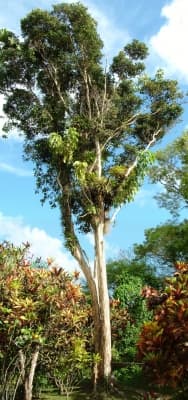
Pimenta racemosa
Pimenta racemosa
Safety & Hazards
The fruit, the essential oil in the leaves and the bay rum made from it, are all toxic and should not be ingested[1]. Bay rum, as used in hair dressings and aftershaves, may cause irritation of the skin[2]. The essential oil is approved for food use by the Food and Drug Administration of the United States and is 'generally recognized as safe' (GRAS). However, contact dermatitis caused by the components eugenol and phellandrene of the essential oil has been reported[2].
Cultivation Details
A plant of lowland tropical areas, where it is found at elevations up to 750 metres[2]. It grows best in areas where the mean annual temperate is within the range 22 - 28°c, but can tolerate 18 - 32°c[3]. It can tolerate occasional very light frosts, the leaves being damaged at temperatures of -1°c, and limbs being killed at -3°c[1]. It prefers a mean annual rainfall of 1,400 - 2,000mm, but can tolerate 700 - 2,800mm[3]. Prefers an annual rainfall of 2,500mm evenly distributed over the year with few months with less than 200 mm rainfall, although natural stands occur in areas with only 750 mm annual rainfall[2]. Although trees grow well with 1,250 - 1,500mm annual rainfall, regrowth following pruning is too slow for commercial plantations to be profitable[2]. Prefers a sunny position, succeeding in most soils that are well-drained[3]. Growth is best on deep fertile loamy soils with a slightly acid to neutral pH, but most plantations are on marginal soils on slopes, better soils being allocated to food crops[2]. Prefers a pH in the range 5 - 6, tolerating 4.5 - 7[3]. After planting, young plants require protection from direct sunlight until they are well established[2]. Topped seedlings often produce several main shoots. Two main shoots are sometimes retained, since experience has shown that foliage yield is higher than from single-stemmed trees[2]. After 2 - 3 years, the trees are topped at 3 - 5 metres and are maintained at that height. Trees coppice well - misshapen or diseased trees can be cut back to ground level, allowing a new shoot to grow from the stump[2]. Well managed groves are harvested once a year or 3 times in 4 years. The harvesting interval depends more on the age of the leaves than on the rate of regrowth. Leaves are shed after 2 - 3 years, so a harvesting interval longer than 2 years may result in reduced yields[2]. Harvesting can be done year-round, though dry periods are preferred. It is not clear whether the higher yield during this period is due to a higher leaf oil content or to a higher proportion of mature leaves[2]. Leaf yield in established groves may vary between 8 - 35 t/ha (with an oil content of 1 - 3.5%)[2]. The life of plantations is indeterminate, as trees regenerate from stumps, but the effect of regular harvesting on the life expectancy is not known. Individual trees of 50 years old are known[2]. A variable plant, with several varieties being recognized[2]. The var grisea yields a very inferior essential oil that, if combined with other varieties, can have a very negative effect on oil quality[2]. Care should be taken to remove any spontaneous seedlings that do not yield commercially acceptable bay leaf oil[2].
Propagation
Seed - best sown as soon as it is ripe[2]. Germination generally takes 2 - 6 weeks. Seedlings are ready for transplanting to the field in 18 - 24 months[2]. Before planting the stem is topped to 15 cm and the taproot is pruned to 7 cm to encourage lateral rooting[2]. Vegetative propagation is rarely practised, but budding which is applied successfully to Pimenta dioica is probably suitable for this species as well[2]. Cite as: Tropical Plants Database, Ken Fern. tropical.theferns.info. 2026-02-20. <tropical.theferns.info/viewtropical.php?id=Pimenta+racemosa>
Pollinators
Data unavailable
References
- [1]Desert Tropicals — http://www.desert-tropicals.com/ ↩︎The main focus of the site is succulent plants, but it also contains information on a wide range of other species. Usually at least one good photograph, plus basic information about the plant and its cultivation.
- [2]Plant Resources of Southeast Asia — http://proseanet.org/ ↩︎Lots of information on the uses of the plants of SE Asia.
- [3]Ecocrop — http://ecocrop.fao.org/ecocrop/srv/en/home ↩︎Basic information on a wide range of useful plants, plus details of environmental needs where available.
- [4]Common Trees of Puerto Rico and the Virgin Islands — Little E.L.; Wadsworth F.H. · USDA, Forest Service; Washington. · 1964 ↩︎Contains detailed information, and usually an illustration, on 250 tree species, including both native and exotic species.
- [5]Medicinal Plants of the Guianas — DeFilipps, R. A.; Maina, S. L.; & Crepin, J. · Smithsonian Museum · http://botany.si.edu/bdg/medicinal/index.html ↩︎A down-loadable PDF document of a book in pre-publication awaiting illustration. An excellent, if rather terse, guide to the traditional medicinal uses of the plants of the region
- [6]Dictionary of Economic Plants. — Uphof. J. C. Th. · Weinheim · 1959 · ISBN - ↩︎An excellent and very comprehensive guide but it only gives very short descriptions of the uses without any details of how to utilize the plants. Not for the casual reader.
- [7]The Useful and Ornamental Plants of Trinidad and Tobago. — Williams. R. O. & Williams. R. O. Jnr. · Self Published in Trinidad and Tobago. · 1951 ↩︎Terse details of a wide range of plants both native and introduced to Trinidad and Tobago. Gives a brief description of the plant and some of its local uses.