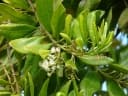
Pimenta dioica
Pimenta dioica
Safety & Hazards
None known
Cultivation Details
A plant of the moist to wet lowland tropics, growing best at elevations below 330 metres but able to be grown up to 1,500 metres. It grows best in areas where annual daytime temperatures are within the range 15 - 32°c, but can tolerate 10 - 35°c[1]. It prefers a mean annual rainfall in the range 1,500 - 2,500mm, but tolerates 1,000 - 3,500mm[1]. Prefers a rich, well-drained sandy soil in a sunny position[2]. Prefers a pH in the range 7 - 7.5, tolerating 6.3 - 8[1]. A slow-growing plant, it takes 20 years to flower from seed[3]. Trees may come into bearing in 5 - 10 years, but require 20 - 25 years for full harvest to be achieved[1]. They have an economical life of about 50 years[1]. Young trees 10 - 15 years old may yield 23 - 60 kilos of green pimento berries in a good year, but fail to crop in a bad year[1]. Average yield is about 5 kilos per tree[1]. Plants can be harvested every third year[1]. The berries and leaves are usually not harvested from the same tree[1]. The forms from the West Indies have smaller fruits that contain more than twice as much essential oil as forms from Central America[4].
Propagation
Seed - Cuttings of half-ripe wood. Cite as: Tropical Plants Database, Ken Fern. tropical.theferns.info. 2026-02-20. <tropical.theferns.info/viewtropical.php?id=Pimenta+dioica>
Pollinators
Bees
References
- [1]Ecocrop — http://ecocrop.fao.org/ecocrop/srv/en/home ↩︎Basic information on a wide range of useful plants, plus details of environmental needs where available.
- [2]Encyclopaedia of Herbs and their Uses. — Bown. D. · Dorling Kindersley, London. · 1995 · ISBN 0-7513-020-31 ↩︎A very well presented and informative book on herbs from around the globe. Plenty in it for both the casual reader and the serious student. Just one main quibble is the silly way of having two separate entries for each plant.
- [3]Tropical and Subtropical Trees - A Worldwide Encyclopaedic Guide. — Barwick. M. · Thames & Hudson, London · 2004 · ISBN 0-500-51181-0 ↩︎A superb book, very concise and well written, giving a wealth of information on 400 or more species including descriptions, habitat, cultivation details and plant uses. A wealth of colour photographs bring each plant vividly to life.
- [4]Flora of Guatemala — Standley P.C. & J. A. Steyermark · 1946 - 1976 · http://www.archive.org/ ↩︎A superb reference, though somewhat dated. Gives lots of plant uses as well as information on plant habit and habitat. The entire flora (13 volumes) can now be downloaded from http://www.archive.org/
- [5]Plant Resources of Southeast Asia — http://proseanet.org/ ↩︎Lots of information on the uses of the plants of SE Asia.
- [6]The Encyclopedia of Medicinal Plants — Chevallier. A. · Dorling Kindersley. London · 1996 · ISBN 9-780751-303148 ↩︎An excellent guide to over 500 of the more well known medicinal herbs from around the world.
- [7]Cornucopia II — Facciola. S. · Kampong Publications, California. · 1998 · ISBN 0-9628087-2-5 ↩︎The second edition of an excellent guide to the edible uses of plants, though it does not give any details of cultivation etc.
- [8]Medicinal Plants of the Guianas — DeFilipps, R. A.; Maina, S. L.; & Crepin, J. · Smithsonian Museum · http://botany.si.edu/bdg/medicinal/index.html ↩︎A down-loadable PDF document of a book in pre-publication awaiting illustration. An excellent, if rather terse, guide to the traditional medicinal uses of the plants of the region