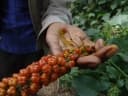
Phytolacca dodecandra
Phytolacca dodecandra
Safety & Hazards
Very poisonous[1]. Eating the fruits or leaves may cause acute poisoning, resulting in nausea, bloody diarrhoea, intense congestion of the stomach and intestines, vomiting, weakness, weak and irregular pulse, dilated pupils, swelling of the mucous membrane in the mouth and stupor; death may occur within a few days[2]. Although the solutions of crushed fruits kill a range of aquatic life forms, including small fish, leeches, mosquito larvae, other stages of the bilharzia life-cycle (miracidia and cercariae), zebra mussels and tadpoles, the active ingredients are easily biodegradable and are eliminated from the water within 48 hours. Insect larvae and tadpoles are not affected at the concentrations that kill fish and snails[2].
Cultivation Details
A plant of the tropics. It grows best in areas with an annual rainfall of about 1,400mm and a distinct dry period[2]. In areas with high evapotranspiration, especially at lower elevations (below 1,500 metres) partial shade should be available so that the plants do not burn and wilt[2]. Prefers a sunny position[2]. Full shade substantially lowers both fruit yield and saponin concentration[2]. The plant is found in the wild in humid, weakly acidic soils that contain high levels of organic matter[2]. In some areas the plant can flower and fruit all year round, though in others it tends to have two flowering periods a year[2]. Annual fruit yield increases with the age of the plant up to about 15 years, with the greatest increase occurring between the first and third year[2]. In a field trial in Ethiopia, different cultivars yielded from 1,050 - 2,750 kg/ha of dried fruits, with a saponin content of 20 - 25%[2]. The yield of dry fruits can increase to 3,000 kg/ha in the fourth year after planting, slowly rising to a maximum of about 4,000 kg/ha[2]. The content of saponins varies seasonally: fruits harvested during the dry season just before the onset of the rains have the highest content.[2]. The harvested fruits must be dried immediately after collection in the open under shade or in the sun. Whole and powdered fruits can be stored at room temperature for up to 4 years without losing potency. Crushed fresh fruits or solutions prepared from them lose their potency within a few days. While grinding the dried fruits care should be taken protect the eyes from the irritating dust[2]. Young plants establish well and grow away quickly. From seed, they commence flowering when only two years old, whilst from cuttings they flower when only 6 months old[2]. A well-established plant has only a few but long roots that reach great depths[2]. Several highly molluscicidal and productive cultivars have been selected, and agronomic trials of the plant have been effected in eastern and southern Africa[2]. A dioecious species - both male and female forms need to be grown if fruit and seeds are required.
Propagation
Seed - germination can be improved by scarification with sand. The seed takes about 14 days to germinate[2]. Fruits can be stored for up to one year without loss of viability, but after 4 years of storage, germination declines by 14%[2]. Cuttings of non-woody shoots with 2 - 3 nodes, taken from the top or middle part of the plant[2]. Rooting occurs with or without application of plant growth regulators[2]. Cite as: Tropical Plants Database, Ken Fern. tropical.theferns.info. 2026-02-20. <tropical.theferns.info/viewtropical.php?id=Phytolacca+dodecandra>
Pollinators
Insects
References
- [1]African Flowering Plants Database — Conservatoire et Jardin Botaniques. · http://www.ville-ge.ch/musinfo/bd/cjb/africa/recherche.php ↩︎Contains information on over 150,000 plant names (including synonyms) giving a description and habitat, plus a distribution map.
- [2]Protabase - Plant Resources of Tropical Africa. — http://www.prota.org ↩︎An excellent on-line database with detailed information on over 3,200 species of useful plants of Africa.
- [3]Dictionary of Economic Plants. — Uphof. J. C. Th. · Weinheim · 1959 · ISBN - ↩︎An excellent and very comprehensive guide but it only gives very short descriptions of the uses without any details of how to utilize the plants. Not for the casual reader.