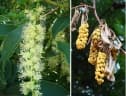
Phytolacca dioica
Phytolacca dioica
Safety & Hazards
The leaves are poisonous. They are said to be alright to eat when young, the toxins developing as they grow older. Other parts of the plant, including the fruit, are likely to be poisonous. The seeds, leaf and root contain saponins[1]. Although poisonous, saponins are poorly absorbed by the human body and so most pass through without harm. Saponins are quite bitter and can be found in many common foods such as some beans. They can be removed by carefully leaching in running water. Thorough cooking, and perhaps changing the cooking water once, will also normally remove most of them. However, it is not advisable to eat large quantities of raw foods that contain saponins. Saponins are much more toxic to some creatures, such as fish, and hunting tribes have traditionally put large quantities of them in streams, lakes etc in order to stupefy or kill the fish[PFAF].
Cultivation Details
Phytolacca dioica is a plant of the moist tropics and subtropics, where it is found at elevations up to 2,000 metres. It grows best in areas where annual daytime temperatures are within the range 18 - 32°c, but can tolerate 12 - 38°c[2]. When dormant, the plant can survive temperatures down to about -5°c, but young growth can be severely damaged at -1°c[2]. It prefers a mean annual rainfall in the range 800 - 1,500mm, but tolerates 600 - 5,000mm[2]. An easily grown plant, succeeding in most soils[3], though preferring a moisture retentive fertile soil in full sun or partial shade[4]. Prefers a pH in the range 5.5 - 7, tolerating 5 - 7.5[2]. Established plants are very drought tolerant[5]. Tolerant of coastal salt spray and strong winds, including hurricanes[1, 2]. Plants can be grown in quite coarse grass, which can be cut annually in the autumn[6]. Young trees establish well and grow away quickly - they can easily reach a height of 4 - 5 metres in two years[7]. An aggressive plant to grow in gardens, it has root suckers that appear readily above the soil[1, 2]. Plants seem to be immune to the predations of rabbits[6]. Dioecious, both male and female forms need to be grown if fruit and seed are required[5]. The small, wind-pollinated flowers are extremely malodorous[5].
Propagation
Seed - does not require pre-treatment. Best sown as soon as ripe in containers or a seed bed in a position in light shade[7]. When they are 4 - 5cm tall, prick the seedlings out into individual pots and grow them on until large enough to plant out, which should be about 4 months later[7]. Cite as: Tropical Plants Database, Ken Fern. tropical.theferns.info. 2026-02-20. <tropical.theferns.info/viewtropical.php?id=Phytolacca+dioica>
Pollinators
Wind
References
- [1]World Agroforesty Centre — http://www.worldagroforestry.org/ ↩︎An excellent online database of a huge range of trees giving very good information on each plant - its uses, ecology, identity, propagation, pests etc.
- [2]Ecocrop — http://ecocrop.fao.org/ecocrop/srv/en/home ↩︎Basic information on a wide range of useful plants, plus details of environmental needs where available.
- [3]RHS Dictionary of Plants plus Supplement. 1956 — F. Chittendon. · Oxford University Press · 1951 · ISBN - ↩︎Comprehensive listing of species and how to grow them. Somewhat outdated, it has been replaced in 1992 by a new dictionary (see [ 200 ]).
- [4]The New RHS Dictionary of Gardening. 1992. — Huxley. A. · MacMillan Press · 1992 · ISBN 0-333-47494-5 ↩︎Excellent and very comprehensive, though it contains a number of silly mistakes. Readable yet also very detailed.
- [5]Tropical and Subtropical Trees - A Worldwide Encyclopaedic Guide. — Barwick. M. · Thames & Hudson, London · 2004 · ISBN 0-500-51181-0 ↩︎A superb book, very concise and well written, giving a wealth of information on 400 or more species including descriptions, habitat, cultivation details and plant uses. A wealth of colour photographs bring each plant vividly to life.
- [6]Perennial Garden Plants — Thomas. G. S. · J. M. Dent & Sons, London. · 1990 · ISBN 0 460 86048 8 ↩︎A concise guide to a wide range of perennials. Lots of cultivation guides, very little on plant uses.
- [7]Brazilian Trees. Volume 1. 4th Edition. — Lorenzi. H. · Instituto Plantarum De Estudos Da Flora; Brazil. · 2002 · ISBN 85-86714-17-8 ↩︎Information on 350 species of Brazilian trees. Stunning photographs of each species, brief details on the plant, its uses and how to grow it from seed. A superb work, with the minor irritation that the translation from Portuguese is not of the best.
- [8]Cornucopia - A Source Book of Edible Plants. — Facciola. S. · Kampong Publications · 1990 · ISBN 0-9628087-0-9 ↩︎Excellent. Contains a very wide range of conventional and unconventional food plants (including tropical) and where they can be obtained (mainly N. American nurseries but also research institutes and a lot of other nurseries from around the world.
- [PFAF]Plants for a Future — pfaf.org ↩︎