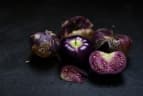
Physalis philadelphica
Physalis philadelphica
Safety & Hazards
The unripe fruits and foliage of Physalis species contain solanine and other solanidine alkaloids and are toxic if ingested in large quantities. The ripe fruiys are usually edible, and several species are cultivated for these fruits[1]. All parts of the plant, except the fruit, are poisonous[2, 3].
Cultivation Details
Physalis philadelphica is a plant of the tropics and subtropics, where it is found at elevations up to 2,600 metres. It grows best in areas where annual daytime temperatures are within the range 15 - 25°c, but can tolerate 8 - 31°c[4]. It is not tolerant of frost[PFAF]. It prefers a mean annual rainfall in the range 700 - 1,000mm, but tolerates 600 - 1,100mm[4]. Succeeds in any well-drained soil in full sun or light shade[5]. Prefers a pH in the range 6 - 7, tolerating 5 - 8[4]. There are some named varieties[6, 5]. 'Purple de Milpa' has small purple-tinged fruits with a sharp flavour, they keep well[5]. The plant can flower all year round when growing in frost-free climates[1].
Propagation
Seeds can remain viable in the soil for several years[1]. Seed - sow early to mid spring in a greenhouse only just covering the seed. Germination usually takes place quickly and freely. Prick out the seedlings into individual pots of fairly rich soil when they are large enough to handle and plant them out after the last expected frosts. Consider giving them some protection such as a cloche until they are growing away well. Diurnal temperature fluctuations assist germination[7]. Cite as: Temperate Plants Database, Ken Fern. temperate.theferns.info. 2026-02-21. <temperate.theferns.info/plant/Physalis+philadelphica>
Pollinators
Insects
References
- [1]Flora of N. America — http://flora.huh.harvard.edu/fna/ ↩︎An on-line version of the flora with an excellent description of the plant including a brief mention of plant uses.
- [2]Poisonous Plants. — Stary. F. · Hamlyn · 1983 · ISBN 0-600-35666-3 ↩︎Not very comprehensive, but easy reading.
- [3]A Colour Atlas of Poisonous Plants. — Frohne. D. and Pfänder. J. · Wolfe · 1984 · ISBN 0723408394 ↩︎Brilliant. Goes into technical details but in a very readable way. The best work on the subject that I've come across so far.
- [4]Ecocrop — http://ecocrop.fao.org/ecocrop/srv/en/home ↩︎Basic information on a wide range of useful plants, plus details of environmental needs where available.
- [5]The New RHS Dictionary of Gardening. 1992. — Huxley. A. · MacMillan Press · 1992 · ISBN 0-333-47494-5 ↩︎Excellent and very comprehensive, though it contains a number of silly mistakes. Readable yet also very detailed.
- [6]Cornucopia - A Source Book of Edible Plants. — Facciola. S. · Kampong Publications · 1990 · ISBN 0-9628087-0-9 ↩︎Excellent. Contains a very wide range of conventional and unconventional food plants (including tropical) and where they can be obtained (mainly N. American nurseries but also research institutes and a lot of other nurseries from around the world.
- [7]Ground Cherries, Husk Tomatoes and Tomatilloes. — Dremann. C. G. · Redwood City Seed Co · 1985 · ISBN 0-933421-03-6 ↩︎Only a small booklet but it covers the various species in some depth.
- [8]Flora Europaea — ? · Cambridge University Press · 1964 · ISBN - ↩︎An immense work in 6 volumes (including the index). The standard reference flora for Europe, it is very terse though and with very little extra information. Not for the casual reader.
- [9]IUCN Red List of Threatened Species — http://www.iucnredlist.org/ ↩︎A list of plants under threat and facing possible extinction, usually with brief details of the threats and information on habitat.
- [10]Sturtevant's Edible Plants of the World. — Hedrick. U. P. · Dover Publications · 1972 · ISBN 0-486-20459-6 ↩︎Lots of entries, quite a lot of information in most entries and references.
- [11]Tanaka's Cyclopedia of Edible Plants of the World. — Tanaka. T. & Nakao S. · Keigaku Publishing; Tokyo · 1976 · ISBN - ↩︎The most comprehensive list of edible plants I've come across. Only the briefest entry for each species, though, and some of the entries are more than a little dubious. Not for the casual reader.
- [12]Native American Ethnobotany — Moerman. D. · Timber Press. Oregon. · 1998 · ISBN 0-88192-453-9 ↩︎Very comprehensive but terse guide to the native uses of plants. Excellent bibliography, fully referenced to each plant, giving a pathway to further information. Not for the casual reader.
- [PFAF]Plants for a Future — pfaf.org ↩︎