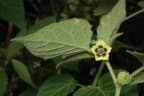
Physalis peruviana
Physalis peruviana
Safety & Hazards
The unripe fruits and foliage of Physalis species contain solanine and other solanidine alkaloids and are toxic if ingested in large quantities. The ripe fruiys are usually edible, and several species are cultivated for these fruits[1]. All parts of the plant, except the fruit, are poisonous[2, 3].
Cultivation Details
Cape gooseberry is a plant of moderate to higher elevations in the tropics - especially if treated as an annual. It can be successfully grown from the warm temperate zone to the tropics[4]. In the tropics, elevations above 800 metres produce better yields[5]. The plant grows best in areas where the mean annual temperatures are within the range 16 - 25°c, though it can tolerate 10 - 32°c[4]. It prefers a mean annual rainfall in the range 1,500 - 2,300, tolerating 800 - 4,300[4]. Plants are tolerant of light frosts[6]. Succeeds in a sheltered position in any well-drained soil in full sun or light shade[7, 8]. Prefers a humus-rich loam[9, 5] but tolerates poor soils[7]. Dislikes clay soils[5]. If the soil is too rich it encourages leaf production at the expense of fruiting[7]. Plants tolerate a pH in the range 4.5 to 8.2[7]. A first harvest of fruits can be obtained about 3 months after sowing the seed, harvesting can continue for at least 3 years[5]. The plant can flower and fruit all year-round when growing in frost-free areas[4]. Yields of 20 tonnes per hectare are common in S. America, 33 tonnes has been achieved[7].
Propagation
Seed - sow early to mid spring in a greenhouse only just covering the seed. Germination usually takes place quickly and freely. Prick out the seedlings into individual pots of fairly rich soil when they are large enough to handle and plant them out after the last expected frosts. Consider giving them some protection such as a cloche until they are growing away well. Diurnal temperature fluctuations assist germination[10]. Division in spring[11]. This is best done without digging up the plant. Remove young shoots that are growing out from the side of the clump, making sure that some of the below ground shoot is also removed. It is best if this has some roots on, but the shoot should form new roots fairly quickly if it is potted up and kept for a few weeks in a shady but humid part of the greenhouse[PFAF]. Cite as: Temperate Plants Database, Ken Fern. temperate.theferns.info. 2026-02-21. <temperate.theferns.info/plant/Physalis+peruviana>
Pollinators
Bees, wind
References
- [1]Flora of N. America — http://flora.huh.harvard.edu/fna/ ↩︎An on-line version of the flora with an excellent description of the plant including a brief mention of plant uses.
- [2]Poisonous Plants. — Stary. F. · Hamlyn · 1983 · ISBN 0-600-35666-3 ↩︎Not very comprehensive, but easy reading.
- [3]A Colour Atlas of Poisonous Plants. — Frohne. D. and Pfänder. J. · Wolfe · 1984 · ISBN 0723408394 ↩︎Brilliant. Goes into technical details but in a very readable way. The best work on the subject that I've come across so far.
- [4]Ecocrop — http://ecocrop.fao.org/ecocrop/srv/en/home ↩︎Basic information on a wide range of useful plants, plus details of environmental needs where available.
- [5]Vegetables in the Tropics — Tindall. H. D. · MacMillan, Oxford. · 1983 · ISBN 0-333-24268-8 ↩︎An excellent, in-depth look at the main vegetable crops that can be grown in the Tropics, plus many less well-known plants.
- [6]Annals of the Missouri Botanical Garden Vol. 65 — Missouri Botanical Garden · 1978 ↩︎An excellent botanical publication, available for download from the Internet. This volume contains parts of the Flora of Panama.
- [7]Lost Crops of the Incas — Popenoe. H. et al · National Academy Press · 1990 · ISBN 0-309-04264-X ↩︎An excellent book. Very readable, with lots of information and good pictures of some lesser known food plants of S. America.
- [8]The New RHS Dictionary of Gardening. 1992. — Huxley. A. · MacMillan Press · 1992 · ISBN 0-333-47494-5 ↩︎Excellent and very comprehensive, though it contains a number of silly mistakes. Readable yet also very detailed.
- [9]Simmons' Manual of Fruit. — Simmons A. E. · David & Charles; Newton Abbot. · 1978 · ISBN 0-7153-7607-1 ↩︎A good guide to some of the cultivars of temperate fruits. It covers quite a wide range of fruits.
- [10]Ground Cherries, Husk Tomatoes and Tomatilloes. — Dremann. C. G. · Redwood City Seed Co · 1985 · ISBN 0-933421-03-6 ↩︎Only a small booklet but it covers the various species in some depth.
- [11]Popular Hardy Perennials. — Sanders. T. W. · Collingridge · 1926 · ISBN - ↩︎A fairly wide range of perennial plants that can be grown in Britain and how to grow them.
- [12]RHS Dictionary of Plants plus Supplement. 1956 — F. Chittendon. · Oxford University Press · 1951 · ISBN - ↩︎Comprehensive listing of species and how to grow them. Somewhat outdated, it has been replaced in 1992 by a new dictionary (see [ 200 ]).
- [13]Sturtevant's Edible Plants of the World. — Hedrick. U. P. · Dover Publications · 1972 · ISBN 0-486-20459-6 ↩︎Lots of entries, quite a lot of information in most entries and references.
- [14]Growing Unusual Fruit. — Simmons. A. E. · David & Charles; Newton Abbot. · 1972 · ISBN 0-7153-5531-7 ↩︎A very readable book with information on about 100 species that can be grown in Britain (some in greenhouses) and details on how to grow and use them.
- [15]The Oxford Book of Food Plants. — Harrison. S. Wallis. M. Masefield. G. · Oxford University Press · 1975 · ISBN - ↩︎Good drawings of some of the more common food plants from around the world. Not much information though.
- [16]Cornucopia - A Source Book of Edible Plants. — Facciola. S. · Kampong Publications · 1990 · ISBN 0-9628087-0-9 ↩︎Excellent. Contains a very wide range of conventional and unconventional food plants (including tropical) and where they can be obtained (mainly N. American nurseries but also research institutes and a lot of other nurseries from around the world.
- [17]Glossary of Indian Medicinal Plants (Including the Supplement). — Chopra. R. N., Nayar. S. L. and Chopra. I. C. · Council of Scientific and Industrial Research, New Delhi. · 1986 · ISBN - ↩︎Very terse details of medicinal uses of plants with a wide range of references and details of research into the plants chemistry. Not for the casual reader.
- [18]Plant Resources of Southeast Asia — http://proseanet.org/ ↩︎Lots of information on the uses of the plants of SE Asia.
- [PFAF]Plants for a Future — pfaf.org ↩︎