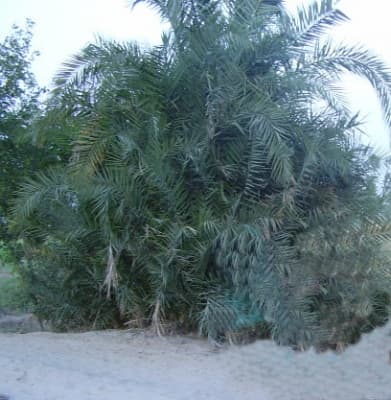
Phoenix sylvestris
Phoenix sylvestris
Safety & Hazards
None known
Cultivation Details
A plant of the drier to moist tropics and subtropics, where it is found at elevations up to 1,500 metres. It grows best in areas where annual daytime temperatures are within the range 25 - 35°c, but can tolerate 20 - 40°c[1]. When dormant, the plant can survive temperatures down to about -9°c, but young growth can be severely damaged at -1°c[1]. It prefers a mean annual rainfall in the range 400 - 700mm, but tolerates 250 - 1,000mm[1]. Requires an open sunny position[2]. Plants grow well in full sun, even when small[3]. Requires a well-drained soil[4]. It can grow in a wide range of soil types but prefers sandy well drained but moist soils[1]. It will not survive in wet or badly drained soils[1]. Prefers a pH in the range 5.5 - 7.5, tolerating 5 - 8[1]. Plants can tolerate at least some maritime exposure with salt spray and somewhat saline soil conditions[3]. Established plants are drought tolerant[4]. A fast-growing plant[1]. Phoenix species are quite liable to hybridize where the various species meet as a result of cultivation[5]. A dioecious species, both male and female forms need to be grown if fruit and seed are required.
Propagation
Seed - probably best sown as soon as it is ripe in a warm greenhouse, otherwise sow the seed as soon as you obtain it. Germination usually takes place within 2 - 3 months. When they are large enough to handle, prick the seedlings out into individual pots and grow them on in the greenhouse for at least their first winter. Plant them out into their permanent positions in late spring or early summer, after the last expected frosts. Give the plants some protection from the cold for at least their first winter outdoors. Cite as: Temperate Plants Database, Ken Fern. temperate.theferns.info. 2026-02-21. <temperate.theferns.info/plant/Phoenix+sylvestris>
Pollinators
Data unavailable
References
- [1]Ecocrop — http://ecocrop.fao.org/ecocrop/srv/en/home ↩︎Basic information on a wide range of useful plants, plus details of environmental needs where available.
- [2]Palms for Cooler Climates. — McMillan-Browse. P. · Trebah Enterprises. · 1993 · ISBN 0 9521952 0 8 ↩︎An excellent little booklet on the subject, though it does not mention many plant uses.
- [3]Palms of the World — Blombery. A. & Rodd. T. · Angus and Robertson · 1992 · ISBN 0-207-14848-1 ↩︎An excellent guide, well illustrated, with information on cultivation, uses, habitat etc of almost 200 species of Palms.
- [4]Palm and Cycad Societies of Australia. — http://www.pacsoa.org.au/ ↩︎Contains at least a little information on the majority of palm and cycad species, plus a wealth of photographs. A first class website.
- [5]A Monograph of Phoenix L. (Palmae; Coryphoidede) — Barrow S.C. · 1998 · http://10.2307/4110478 ↩︎
- [6]Flowers of India — http://www.flowersofindia.net/ ↩︎A wed site of native Indian plants, plus cultivated and naturalized species. It has good quality photos and terse details on more than 3,000 species and cultivars.
- [7]Flora of Pakistan — http://www.efloras.org ↩︎As of 2006, there is not much information on habitats available, but it is being developed and promises to be an excellent resource.
- [8]Mansfeld's Database of Agricultural and Horticultural Plants — http://mansfeld.ipk-gatersleben.de/pls/htmldb_pgrc/f?p=185:3:4292127278597336 ↩︎Terse details of a huge range of useful plants.
- [9]Cornucopia II — Facciola. S. · Kampong Publications, California. · 1998 · ISBN 0-9628087-2-5 ↩︎The second edition of an excellent guide to the edible uses of plants, though it does not give any details of cultivation etc.
- [10]Sturtevant's Edible Plants of the World. — Hedrick. U. P. · Dover Publications · 1972 · ISBN 0-486-20459-6 ↩︎Lots of entries, quite a lot of information in most entries and references.
- [11]Economic Products of India. Volume 1. — Watt. G. · Government of India: Calcutta. · 1883 ↩︎Although over 100 years old, it still contains a wealth of information on useful plants. Many of the botanical names have been changed since then, so you have to check for up to date names. The book can be downloaded from the Internet.
- [12]Economic Botany. — Hill. A. F. · The Maple Press · 1952 · ISBN - ↩︎Not very comprehensive, but it is quite readable and goes into some detail about the plants it does cover.
- [13]RHS Dictionary of Plants plus Supplement. 1956 — F. Chittendon. · Oxford University Press · 1951 · ISBN - ↩︎Comprehensive listing of species and how to grow them. Somewhat outdated, it has been replaced in 1992 by a new dictionary (see [ 200 ]).