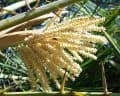
Phoenix reclinata
Phoenix reclinata
Safety & Hazards
None known
Cultivation Details
A plant of the moist tropics, where it is found at elevations up to 3,000 metres, it also grows well in cultivation in Mediterranean-type climates. It grows best in areas where annual daytime temperatures are within the range 20 - 30°c, but can tolerate 15 - 35°c[1]. Although very susceptible to frost damage when young, plants become hardier as they grow older and when mature can tolerate occasional moderate frosts[2, 3, 4, 5]. The plant prefers a mean annual rainfall in the range 800 - 3,000mm, but tolerates 500 - 5,000mm[1]. Plants grow well in full sun, even when small[6]. Plants are tolerant of light shade, though they will not fruit when growing in such a position. Tolerates deep shade[6]. Requires a light moist but very well-drained soil in a sheltered position[3]. Plants tolerate seasonally waterlogged soils in the wild[4, 7]. Succeeds in dry soils and is also tolerant of poor soils. Prefers a pH in the range 5.5 - 7, tolerating 5 - 7.5[1]. Phoenix species are quite liable to hybridize where the various species meet as a result of cultivation[7]. This species hybridizes very freely with P. sylvestris and P. roebelenii[6]. Palms usually have deep penetrating root systems and generally establish best when planted out at a young stage. However, older plants are substantially more cold tolerant than juvenile plants[3]. In areas at the limit of their cold tolerance, therefore, it is prudent to grow the plants in containers for some years, giving them winter protection, and only planting them into their permanent positions when sheer size dictates[3]. This species can be cultivated successfully for a long time in containers[3]. It can also be transplanted even when very large[3]. Although the thick fleshy roots are easily damaged and/or desiccated, new roots are generally freely produced. It is important to stake the plant very firmly to prevent rock, and also to give it plenty of water until re-established - removing many of the leaves can also help[3]. It takes 5 - 6 years from seed before the plant will have produced a full head of leaves and it will not start to form a trunk until this stage is reached[3]. Plants often form suckers around their base[3]. Dioecious, male and female plants must be grown if seed is required.
Propagation
Seed - probably best sown as soon as it is ripe in a warm greenhouse, otherwise sow the seed as soon as you obtain it. Germination usually takes place within 2 - 3 months. When they are large enough to handle, prick the seedlings out into individual pots and grow them on in the greenhouse for at least their first winter. Plant them out into their permanent positions in late spring or early summer, after the last expected frosts. Give the plants some protection from the cold for at least their first winter outdoors. Division of suckers[4]. Cite as: Temperate Plants Database, Ken Fern. temperate.theferns.info. 2026-02-21. <temperate.theferns.info/plant/Phoenix+reclinata>
Pollinators
Wind
References
- [1]Ecocrop — http://ecocrop.fao.org/ecocrop/srv/en/home ↩︎Basic information on a wide range of useful plants, plus details of environmental needs where available.
- [2]The Milder Garden. — Taylor. J. · Dent · 1990 ↩︎A good book on plants that you didn't know could be grown outdoors in Britain.
- [3]Palms for Cooler Climates. — McMillan-Browse. P. · Trebah Enterprises. · 1993 · ISBN 0 9521952 0 8 ↩︎An excellent little booklet on the subject, though it does not mention many plant uses.
- [4]PlantZAfrica.com — http://www.plantzafrica.com ↩︎An excellent site giving detailed descriptions and uses of many S. African plants.
- [5]Palm and Cycad Societies of Australia. — http://www.pacsoa.org.au/ ↩︎Contains at least a little information on the majority of palm and cycad species, plus a wealth of photographs. A first class website.
- [6]Palms of the World — Blombery. A. & Rodd. T. · Angus and Robertson · 1992 · ISBN 0-207-14848-1 ↩︎An excellent guide, well illustrated, with information on cultivation, uses, habitat etc of almost 200 species of Palms.
- [7]A Monograph of Phoenix L. (Palmae; Coryphoidede) — Barrow S.C. · 1998 · http://10.2307/4110478 ↩︎
- [8]Edible Wild Plants of Tanzania — Ruffo, C.K.: Birnie, A. & Tengnas, B. · Regional Land Management Unit; Nairobi. · 2002 · ISBN 9966-896-60-0 ↩︎A very well presented, simple guide to growing and utilizing wild food plants in Tanzania, with line drawings of each plant, a description, habitat and range, non-food as well as food uses, plus basic information on growing the plants.
- [9]World Agroforesty Centre — http://www.worldagroforestry.org/ ↩︎An excellent online database of a huge range of trees giving very good information on each plant - its uses, ecology, identity, propagation, pests etc.
- [10]IUCN Red List of Threatened Species — http://www.iucnredlist.org/ ↩︎A list of plants under threat and facing possible extinction, usually with brief details of the threats and information on habitat.
- [11]Invasive Species Compendium — http://www.cabi.org ↩︎An immense resource - in depth information on over 900 species of invasive plants (it also has information on animals, fungi etc).
- [12]Sturtevant's Edible Plants of the World. — Hedrick. U. P. · Dover Publications · 1972 · ISBN 0-486-20459-6 ↩︎Lots of entries, quite a lot of information in most entries and references.
- [13]Cornucopia II — Facciola. S. · Kampong Publications, California. · 1998 · ISBN 0-9628087-2-5 ↩︎The second edition of an excellent guide to the edible uses of plants, though it does not give any details of cultivation etc.
- [14]The New RHS Dictionary of Gardening. 1992. — Huxley. A. · MacMillan Press · 1992 · ISBN 0-333-47494-5 ↩︎Excellent and very comprehensive, though it contains a number of silly mistakes. Readable yet also very detailed.
- [PFAF]Plants for a Future — pfaf.org ↩︎