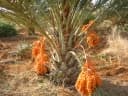
Phoenix dactylifera
Phoenix dactylifera
Safety & Hazards
None known
Cultivation Details
Date palm is a plant of drier areas in the tropics, where it is found at elevations up to 1,500 metres. Hot dry conditions are required for free fruiting, the fruit not forming very readily in cooler or moister climates[1]. It grows best in areas where annual daytime temperatures are within the range 26 - 45°c, but can tolerate 10 - 52°c[2]. When dormant, the plant can survive temperatures down to about -15°c, but the leaves and young growth can be severely damaged at -4°c[2]. It prefers a mean annual rainfall in the range 200 - 300mm, but tolerates 100 - 400mm[2]. The tree transpires large quantities of moisture and the amount of available rainfall is often little, or entirely absent in the production areas. The water requirement of the palm must be provided for by ground water (the roots of the tree can reach 2 - 6 metres deep) or by irrigation[2]. Plants are tolerant of a range of soil types[3], so long as they are well-drained[1]. Plants grow well in full sun, even when small[1]. Tolerant of salty soils, though fruit quality might be adversely affected[4, 5]. Prefers a pH in the range 6.5 - 8, tolerating 6 - 8.5[2]. The plant has escaped from cultivation and become established as a weed on several Pacific Islands, including Hawaii[6]. Seedlings begin to develop a stem when about 4 - 5 years old and will usually start flowering soon afterwards[5]. Plants propagated from suckers can commence fruiting within 2 - 4 years and normally reach full production at 5 - 8 years, although productivity may increase up to 9 - 15 years[2]. Pollination is critical for good fruiting; therefore, pollen is usually artificially introduced to the female flowers by cutting a male inflorescence and placing it strategically within a female inflorescence - this may be thinned a little to accommodate it. It is important that male trees are planted with females in ratios of about 1:50 in order to provide sufficient pollen[5]. An average well-managed palm can produce about 60 - 70 kilos of fresh dates per year[2]. Commercially, yields of dates are often restricted to about 50 kilos per tree in order to ensure high quality, though yields of 100 kilos have been recorded[7]. Yields decline after 40 - 50 years, but the tree will continue to produce until about the age of 75 years[2]. When fruit yields are poor, the tree is often tapped for its sap. The yield varies with management and site conditions, but it is in the range of 4 - 8 litres per day[5]. There are many named forms[7]. Phoenix species are quite liable to hybridize where the various species meet as a result of cultivation[8]. A dioecious species, at least one male plant for every 6 females is necessary to ensure fertilization[1].
Propagation
Seed - pre-soak for 24 hours in warm water and sow in containers. Germination usually takes place in 2 - 3 months[1]. Seed viability can be maintained for 8 - 15 years at room temperature[5]. Division of suckers[1]. Pot up immediately into large containers and plant into permanent positions once the plant is established[1]. Cite as: Tropical Plants Database, Ken Fern. tropical.theferns.info. 2026-02-20. <tropical.theferns.info/viewtropical.php?id=Phoenix+dactylifera>
Pollinators
Data unavailable
References
- [1]Palms of the World — Blombery. A. & Rodd. T. · Angus and Robertson · 1992 · ISBN 0-207-14848-1 ↩︎An excellent guide, well illustrated, with information on cultivation, uses, habitat etc of almost 200 species of Palms.
- [2]Ecocrop — http://ecocrop.fao.org/ecocrop/srv/en/home ↩︎Basic information on a wide range of useful plants, plus details of environmental needs where available.
- [3]Perennial Edible Fruits of the Tropics : an Inventory — Martin, F. W.; Campbell, C. W.; Rubertbe, R. M. · U.S. Dept. of Agriculture, Agricultural Research Service · 1987 ↩︎A booklet giving terse details of almost 300 species of edible fruits, plus regional lists of Botanical and Common names for over 2,500 less well-known edible fruits of the tropics.
- [4]Tropical Ornamentals; A Guide — Whistler. W. Arthur. · Timber Press Inc. Oregon. · 2000 · ISBN 0-88192-448-2 ↩︎An excellent little guide to some of the more commonly cultivated ornamental plants of the Tropics, often giving some information on the plants other uses.
- [5]World Agroforesty Centre — http://www.worldagroforestry.org/ ↩︎An excellent online database of a huge range of trees giving very good information on each plant - its uses, ecology, identity, propagation, pests etc.
- [6]Invasive Species Compendium — http://www.cabi.org ↩︎An immense resource - in depth information on over 900 species of invasive plants (it also has information on animals, fungi etc).
- [7]The New RHS Dictionary of Gardening. 1992. — Huxley. A. · MacMillan Press · 1992 · ISBN 0-333-47494-5 ↩︎Excellent and very comprehensive, though it contains a number of silly mistakes. Readable yet also very detailed.
- [8]A Monograph of Phoenix L. (Palmae; Coryphoidede) — Barrow S.C. · 1998 · http://10.2307/4110478 ↩︎
- [9]Cornucopia II — Facciola. S. · Kampong Publications, California. · 1998 · ISBN 0-9628087-2-5 ↩︎The second edition of an excellent guide to the edible uses of plants, though it does not give any details of cultivation etc.
- [10]Heart of Palm Use: A Family Survey — Scott Zona, Ph.D. · Fairchild Tropical Botanic Garden, Virtual Herbarium. · http://www.virtualherbarium.org/palmresearch/Hearts_of_Palm_table.html ↩︎An on-line article listing the botanical names and range of palm trees that have an edible apical bud.
- [11]Dictionary of Economic Plants. — Uphof. J. C. Th. · Weinheim · 1959 · ISBN - ↩︎An excellent and very comprehensive guide but it only gives very short descriptions of the uses without any details of how to utilize the plants. Not for the casual reader.
- [12]CosIng — http://ec.europa.eu/growth/tools-databases/cosing/ ↩︎CosIng is the European Commission database for information on cosmetic substances and ingredients.
- [PFAF]Plants for a Future — pfaf.org ↩︎