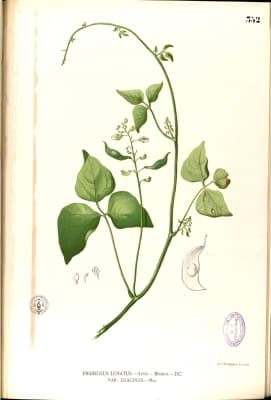
Phaseolus lunatus
Phaseolus lunatus
Safety & Hazards
The raw mature seed, especially of wild forms, is poisonous. The toxic principle is hydrocyanic acid and this is destroyed by thoroughly cooking the seed and discarding the water[1].
Cultivation Details
Phaseolus lunatus is found in the tropical and subtropical regions of South and Central America, and generally grows best in lowland tropical areas at elevations up to 1,500 metres[2].It can also be grown in warmer regions of the temperate zone, so long as there is a sufficiently long enough growing season to ripen the crop. An annual rainfall in the range 900 - 1,500 is adequate[2], but once established the crop tolerates as little as 500 - 600 mm of rainfall[3]. Plants are generally tolerant of heavy rainfall during the growing period, though heavy rain when they are flowering can adversely affect fertilization[2]. A dry period is required for the seeds to mature[2]. Plants are very sensitive to frost, whilst temperatures higher than 30°c adversely affect fertilization, especially in forms that have large seeds[2]. Requires a well-drained moderately fertile soil in a sunny position[1]. Prefers a sandy loam[2].. Plants are prone to drop their flowers when grown in nitrogen-rich soils[1]. Found in the wild on a range of well-drained soils from black clay to brown friable to rocky and sandy (even on sand dunes near beaches) and variously derived from basalt, vokanic ash, limestone. metamorphic schists or volcanic rock[4]. Prefers a pH in the range 6 - 7[2], however some cultivars tolerate acid soils with a pH as low as 4.4[3]. Some climbing forms are more drought resistant than bush forms due to their deep, well-developed root system[3, 2]. Plants can commence producing their edible seedpods in 12 - 16 weeks from seed[1]. The pods can be harvested over a period of several months[2]. Yields of 400 - 1,500 kilos per hectare of dried seed can be obtained[2]. A very variable plant from which a wide range of cultivars have been developed[2]. There are both bush and climbing forms as well as annual and perennial forms[2]. The climbing plants are more productive but bush forms come into bearing more quickly and are probably more suitable for cooler gardens[1]. This species has a symbiotic relationship with certain soil bacteria, these bacteria form nodules on the roots and fix atmospheric nitrogen. Some of this nitrogen is utilized by the growing plant but some can also be used by other plants growing nearby[1].
Propagation
Pre-soak the seed for 12 hours in warm water and sow in mid spring in a greenhouse. Germination should take place within 10 days. When they are large enough to handle, prick the seedlings out into individual pots and plant them out after the last expected frosts. Cite as: Temperate Plants Database, Ken Fern. temperate.theferns.info. 2026-02-21. <temperate.theferns.info/plant/Phaseolus+lunatus>
Pollinators
Bees, Insects
References
- [1]The New RHS Dictionary of Gardening. 1992. — Huxley. A. · MacMillan Press · 1992 · ISBN 0-333-47494-5 ↩︎Excellent and very comprehensive, though it contains a number of silly mistakes. Readable yet also very detailed.
- [2]Vegetables in the Tropics — Tindall. H. D. · MacMillan, Oxford. · 1983 · ISBN 0-333-24268-8 ↩︎An excellent, in-depth look at the main vegetable crops that can be grown in the Tropics, plus many less well-known plants.
- [3]Protabase - Plant Resources of Tropical Africa. — http://www.prota.org ↩︎An excellent on-line database with detailed information on over 3,200 species of useful plants of Africa.
- [4]Taxonomy, Distribution, and Ecology of the Genus Phaseolus (Leguminosae-Papilionoideae) in North America, Mexico and — Freytag G.F. & Debouck D.G. · Botanical Researeh Institute of Texas · 2002 · http://www.brit.org/sida · ISBN 1-889878-11-1 ↩︎An excellent, detailed study of the genus Phaseolus, it has been made available on-line as an open access document.
- [5]Cornucopia - A Source Book of Edible Plants. — Facciola. S. · Kampong Publications · 1990 · ISBN 0-9628087-0-9 ↩︎Excellent. Contains a very wide range of conventional and unconventional food plants (including tropical) and where they can be obtained (mainly N. American nurseries but also research institutes and a lot of other nurseries from around the world.
- [6]Edible Leaves of the Tropics — Martin. F. W.; Ruberte. R. M. & Meitzner. L. S. · Echo. USA. · 1998 · ISBN 0-9653360-1-8 ↩︎A terse guide, giving reasonable detail on the more common leaf crops and brief information on a wide range of lesser known plants.
- [7]Glossary of Indian Medicinal Plants (Including the Supplement). — Chopra. R. N., Nayar. S. L. and Chopra. I. C. · Council of Scientific and Industrial Research, New Delhi. · 1986 · ISBN - ↩︎Very terse details of medicinal uses of plants with a wide range of references and details of research into the plants chemistry. Not for the casual reader.
- [8]Medicinal Plants of the Guianas — DeFilipps, R. A.; Maina, S. L.; & Crepin, J. · Smithsonian Museum · http://botany.si.edu/bdg/medicinal/index.html ↩︎A down-loadable PDF document of a book in pre-publication awaiting illustration. An excellent, if rather terse, guide to the traditional medicinal uses of the plants of the region