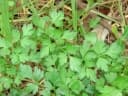
Petroselinum crispum
Petroselinum crispum
Safety & Hazards
Parsley is said to contain the alleged 'psychotroph' myristicine[1]. Excessive contact with the plant can cause skin inflammation[2]. Although perfectly safe to eat and nutritious in amounts that are given in recipes, parsley is toxic in excess, especially when used as an essential oil[3].
Cultivation Details
A plant of the temperate zone, it can also be cultivated in the subtropics and tropics. Parsley, particularly the more upright forms, grows reasonably well at low elevations in the tropics, though better crops are generally obtained at elevations above 600 metres[4, 5]. It grows best in areas where annual daytime temperatures are within the range 11 - 20°c, but can tolerate 7 - 28°c[5]. When dormant, the plant can survive temperatures down to about -5°c, but young growth can be severely damaged at 0°c[5]. It prefers a mean annual rainfall in the range 900 - 1,500mm, but tolerates 300 - 2,800mm[5]. Prefers a moist well-drained soil in sun or partial shade[6, 7, 8, 9, 10, 11]. High temperatures can adversely affect growth, so light shade is often helpful[4]. Prefers a good light soil that is not too light or acid[12], growing poorly in light acid soils[11]. Tolerant of a moderate level of salt in the soil[5]. Prefers a pH in the range 6 - 7.5, tolerating 5.3 - 8.3[5]. Leaves may be harvested 70 - 100 days after transplanting, and harvesting may continue for as long as local climatic conditions allow[5]. Three main groups of varieties have developed over a period of time and these have been grouped into subspecies as detailed below:- Petroselinum crispum crispum. The curly leafed forms of parsley. This is the more ornamental form, especially when used as a dressing in salads, cooked meals etc. It also has a milder flavour. However the curly leaves tend to hold on to surface water and so they are more likely to contract fungal diseases in the winter. Petroselinum crispum neapolitanum Danert. Italian parsley. This has flat, or plain leaves and is considered to have a stronger flavour. This group is also hardier, in part at least because the leaves can shed water easily. Petroselinum crispum tuberosum (Bernh.)Crov. Hamburg parsley is a very distinct form with a swollen root that is used as a vegetable. The leaves are not of such good quality as the preceding forms, but can still be used as a flavouring. Parsley has a long history of use. The ancient Greeks believed that it sprang from the blood of Archemorus, the forerunner of death, and so did not eat it but used it for making wreaths to adorn the dead[13]. The Romans wore garlands of it at feasts in the belief that it would prevent intoxication[13]. They kept it away from nursing mothers, however, believing that it could cause epilepsy in the infant[13]. Parsley is superficially similar to several poisonous species, including Fool's Parsley (Aethusa cynapium)[13]. Great care should be exercised if harvesting the plant from the wild[14, 13]. A good bee plant[15, 16, 17]. A good companion plant, especially for growing near roses, tomatoes, carrots, chives and asparagus[15, 16, 18, 17], giving them all added vigour and protection against certain pests, especially carrot root fly and rose beetles[17].
Propagation
Seed - Three sowings can provide a year round supply of fresh leaves. The first sowing is made in a greenhouse in late winter. Prick out the seedlings into individual pots when they are large enough to handle and plant them out in mid to late spring. The second sowing is made outdoors in situ in the middle of spring and the third is also made in situ outdoors, this time in mid to late summer[12, 19]. Germination usually takes place in about 7 days at 25°c, though it can take 4 - 6 weeks[11]. Germination time can be reduced by pre-soaking the seed for 12 hours in hot water that is allowed to cool quickly, but be careful not to overdo the heat and cook the seed. The seed remains viable in normal storage for 2 - 3 years. Cite as: Temperate Plants Database, Ken Fern. temperate.theferns.info. 2026-02-21. <temperate.theferns.info/plant/Petroselinum+crispum>
Pollinators
Insects
References
- [1]Medicinal Plants of China — Duke. J. A. and Ayensu. E. S. · Reference Publications, Inc. · 1985 · ISBN 0-917256-20-4 ↩︎Details of over 1,200 medicinal plants of China and brief details of their uses. Often includes an analysis, or at least a list of constituents. Heavy going if you are not into the subject.
- [2]Illustrated Flora of North Central Texas — Diggs, Jnr. G.M.; Lipscomb. B. L. & O'Kennon. R. J · Botanical Research Institute, Texas. · 1999 · http://artemis.austincollege.edu/acad/bio/gdiggs/NCTXpdf.htm · ISBN 1-889878-01-4 ↩︎An excellent flora, which is also available on-line.
- [3]Encyclopaedia of Herbs and their Uses. — Bown. D. · Dorling Kindersley, London. · 1995 · ISBN 0-7513-020-31 ↩︎A very well presented and informative book on herbs from around the globe. Plenty in it for both the casual reader and the serious student. Just one main quibble is the silly way of having two separate entries for each plant.
- [4]Vegetables in the Tropics — Tindall. H. D. · MacMillan, Oxford. · 1983 · ISBN 0-333-24268-8 ↩︎An excellent, in-depth look at the main vegetable crops that can be grown in the Tropics, plus many less well-known plants.
- [5]Ecocrop — http://ecocrop.fao.org/ecocrop/srv/en/home ↩︎Basic information on a wide range of useful plants, plus details of environmental needs where available.
- [6]A Modern Herbal. — Grieve. · Penguin · 1984 · ISBN 0-14-046-440-9 ↩︎Not so modern (1930's?) but lots of information, mainly temperate plants.
- [7]New Vegetable Growers Handbook. — Simons. · Penguin · 1977 · ISBN 0-14-046-050-0 ↩︎A good guide to growing vegetables in temperate areas, not entirely organic.
- [8]Shade Plants for Garden and Woodland. — Brown. ↩︎
- [9]The Gardener's Assistant. — Thompson. B. · Blackie and Son. · 1878 · ISBN - ↩︎Excellent general but extensive guide to gardening practices in the 19th century. A very good section on fruits and vegetables with many little known species.
- [10]Salads all the Year Round. — Larkcom. J. · Hamlyn · 1980 ↩︎A good and comprehensive guide to temperate salad plants, with full organic details of cultivation.
- [11]The New RHS Dictionary of Gardening. 1992. — Huxley. A. · MacMillan Press · 1992 · ISBN 0-333-47494-5 ↩︎Excellent and very comprehensive, though it contains a number of silly mistakes. Readable yet also very detailed.
- [12]RHS Dictionary of Plants plus Supplement. 1956 — F. Chittendon. · Oxford University Press · 1951 · ISBN - ↩︎Comprehensive listing of species and how to grow them. Somewhat outdated, it has been replaced in 1992 by a new dictionary (see [ 200 ]).
- [13]Herbs — Phillips. R. & Foy. N. · Pan Books Ltd. London. · 1990 · ISBN 0-330-30725-8 ↩︎Deals with all types of herbs including medicinal, culinary, scented and dye plants. Excellent photographs with quite good information on each plant.
- [14]Encyclopaedia of Medicinal Plants. — Chiej. R. · MacDonald · 1984 · ISBN 0-356-10541-5 ↩︎Covers plants growing in Europe. Also gives other interesting information on the plants. Good photographs.
- [15]Companion Plants. — Philbrick H. and Gregg R. B. · Watkins · 1979 · ISBN - ↩︎Details of beneficial and antagonistic relationships between neighbouring plants.
- [16]Companion Planting for Successful Gardening. — Riotte. L. · Garden Way, Vermont, USA. · 1978 · ISBN 0-88266-064-0 ↩︎Fairly good.
- [17]A - Z of Companion Planting. — Allardice.P. · Cassell Publishers Ltd. · 1993 · ISBN 0-304-34324-2 ↩︎A well produced and very readable book.
- [18]How to Enjoy your Weeds. — Hatfield. A. W. · Frederick Muller Ltd · 1977 · ISBN 0-584-10141-4 ↩︎Interesting reading.
- [19]Growing from Seed. Volume 2. — Rice. G. (Editor) · Thompson and Morgan. · 1988 · ISBN - ↩︎Very readable magazine with lots of information on propagation. An interesting article on Ensete ventricosum.
- [20]Dictionary of Economic Plants. — Uphof. J. C. Th. · Weinheim · 1959 · ISBN - ↩︎An excellent and very comprehensive guide but it only gives very short descriptions of the uses without any details of how to utilize the plants. Not for the casual reader.
- [21]Flora of the British Isles. — Clapham, Tutin and Warburg. · Cambridge University Press · 1962 · ISBN - ↩︎A very comprehensive flora, the standard reference book but it has no pictures.
- [22]The Dictionary of Modern Herbalism. — Mills. S. Y. ↩︎An excellent small herbal.
- [23]Sturtevant's Edible Plants of the World. — Hedrick. U. P. · Dover Publications · 1972 · ISBN 0-486-20459-6 ↩︎Lots of entries, quite a lot of information in most entries and references.
- [24]Food for Free. — Mabey. R. · Collins · 1974 · ISBN 0-00-219060-5 ↩︎Edible wild plants found in Britain. Fairly comprehensive, very few pictures and rather optimistic on the desirability of some of the plants.
- [25]Edible and Medicinal Plants. — Launert. E. · Hamlyn · 1981 · ISBN 0-600-37216-2 ↩︎Covers plants in Europe. a drawing of each plant, quite a bit of interesting information.
- [26]The Herb Book. — Lust. J. · Bantam books · 1983 · ISBN 0-553-23827-2 ↩︎Lots of information tightly crammed into a fairly small book.
- [27]The Vegetable Garden. — Vilmorin. A. · Ten Speed Press · ISBN 0-89815-041-8 ↩︎A reprint of a nineteenth century classic, giving details of vegetable varieties. Not really that informative though.
- [28]Scented Flora of the World. — Genders. R. · Robert Hale. London. · 1994 · ISBN 0-7090-5440-8 ↩︎An excellent, comprehensive book on scented plants giving a few other plant uses and brief cultivation details. There are no illustrations.
- [29]Cornucopia - A Source Book of Edible Plants. — Facciola. S. · Kampong Publications · 1990 · ISBN 0-9628087-0-9 ↩︎Excellent. Contains a very wide range of conventional and unconventional food plants (including tropical) and where they can be obtained (mainly N. American nurseries but also research institutes and a lot of other nurseries from around the world.
- [30]The Encyclopedia of Medicinal Plants — Chevallier. A. · Dorling Kindersley. London · 1996 · ISBN 9-780751-303148 ↩︎An excellent guide to over 500 of the more well known medicinal herbs from around the world.