Cultivation Details
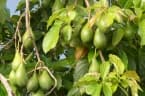
Different forms of the plant can succeed in a range of climates, ranging from subtropical with occasional frosts to lowland and highland tropics, where it can be grown at elevations as high as 2,800 metres. It grows best in areas where annual daytime temperatures are within the range 14 - 40°c, but can tolerate 10 - 45°c[2]. When dormant, the plant can survive temperatures down to about -4°c, but young growth can be severely damaged at -1°c[2]. It prefers a mean annual rainfall in the range 500 - 2,000mm, but tolerates 300 - 2,500mm[2]. Prefers a rich, neutral to alkaline soil and a position in full sun[3]. Succeeds on all kinds of soil[4]. Requires a well-drained soil, the plant is intolerant of water-logging[4, 5]. West Indian rootstocks are fairly tolerant of saline conditions, though other forms are intolerant[4]. Prefers a pH in the range 5 - 5.8, tolerating 4.5 - 7[2]. Requires a position sheltered from strong winds[5]. Seedlings take 6- 8 years to produce fruit, whilst grafts can start fruiting in their second year[5]. Yields of 15 tonnes per hectare have been recorded, but averages are about half that figure[4]. Mature fruit can be left hanging on the tree for weeks without damage[4]. The three main races of Avocado are as follows. There are many named varieties of each race:- Mexican. This is the hardiest form, succeeding in subtropical climates and not well adapted to lowland tropical conditions[1]. It can withstand short periods when temperatures drop as low as -6°c[1]. The optimum temperature for growth is between 14 - 25°c[1]. It has the highest oil content, over 20% and up to 30%[4]. Guatemalan. This form is semitropical. It can withstand short periods when temperatures drop as low as -4°c[1]. The optimum temperature for growth is between 15 - 28°c[1]. It has a medium oil content generally between 10 - 20%[4]. West Indian. This form is wholly tropical and grows well in a lowland tropical climate[1]. It can grow in a temperature range of 12 - 40°c, though the optimum is between 24 - 32°c[1]. It has the lowest oil content, generally below 10%, down to around 3%[4]. Although the flowers are hermaphrodite, the male organ produces pollen when the females are not receptive and so each tree is functionally self-sterile. Therefore at least two different trees are required for pollination[5]. Each avocado flower opens twice. The female part ripens first, then the flower closes to open many hours later in the male stage[4]. In the Mexican form, this gap is more than 24 hours, from morning to the next afternoon, whilst in the Guatemalan it is less than 24 hours[4].
Propagation
Seed - sown fresh it can germinate in about a month - this can be reduced to about 17 days if the seed coat is removed[4]. A regimen of 25°c daytime temperature and 15°cC night-time produces germinates within 3 weeks of sowing fresh seed[6]. The seedlings grow quickly and continuously under warm, moist conditions[6]. Cite as: Tropical Plants Database, Ken Fern. tropical.theferns.info. 2026-02-20. <tropical.theferns.info/viewtropical.php?id=Persea+americana>
Pollinators
Bees, Insects
References
- [1]World Agroforesty Centre — http://www.worldagroforestry.org/ ↩︎An excellent online database of a huge range of trees giving very good information on each plant - its uses, ecology, identity, propagation, pests etc.
- [2]Ecocrop — http://ecocrop.fao.org/ecocrop/srv/en/home ↩︎Basic information on a wide range of useful plants, plus details of environmental needs where available.
- [3]Tropical and Subtropical Trees - A Worldwide Encyclopaedic Guide. — Barwick. M. · Thames & Hudson, London · 2004 · ISBN 0-500-51181-0 ↩︎A superb book, very concise and well written, giving a wealth of information on 400 or more species including descriptions, habitat, cultivation details and plant uses. A wealth of colour photographs bring each plant vividly to life.
- [4]The New RHS Dictionary of Gardening. 1992. — Huxley. A. · MacMillan Press · 1992 · ISBN 0-333-47494-5 ↩︎Excellent and very comprehensive, though it contains a number of silly mistakes. Readable yet also very detailed.
- [5]Tropical Food Gardens — Norrington. L. · Bloomings Books (Melbourne) · 2001 · ISBN 1-876473-41-x ↩︎Excellent little book giving some basic information on a range of plants.
- [6]Plant Resources of Southeast Asia — http://proseanet.org/ ↩︎Lots of information on the uses of the plants of SE Asia.
- [7]Common Trees of Puerto Rico and the Virgin Islands — Little E.L.; Wadsworth F.H. · USDA, Forest Service; Washington. · 1964 ↩︎Contains detailed information, and usually an illustration, on 250 tree species, including both native and exotic species.
- [8]Cornucopia II — Facciola. S. · Kampong Publications, California. · 1998 · ISBN 0-9628087-2-5 ↩︎The second edition of an excellent guide to the edible uses of plants, though it does not give any details of cultivation etc.
- [9]Dictionary of Economic Plants. — Uphof. J. C. Th. · Weinheim · 1959 · ISBN - ↩︎An excellent and very comprehensive guide but it only gives very short descriptions of the uses without any details of how to utilize the plants. Not for the casual reader.
- [10]The Encyclopedia of Medicinal Plants — Chevallier. A. · Dorling Kindersley. London · 1996 · ISBN 9-780751-303148 ↩︎An excellent guide to over 500 of the more well known medicinal herbs from around the world.
- [11]Medicinal Plants of the Guianas — DeFilipps, R. A.; Maina, S. L.; & Crepin, J. · Smithsonian Museum · http://botany.si.edu/bdg/medicinal/index.html ↩︎A down-loadable PDF document of a book in pre-publication awaiting illustration. An excellent, if rather terse, guide to the traditional medicinal uses of the plants of the region
- [12]Encyclopaedia of Herbs and their Uses. — Bown. D. · Dorling Kindersley, London. · 1995 · ISBN 0-7513-020-31 ↩︎A very well presented and informative book on herbs from around the globe. Plenty in it for both the casual reader and the serious student. Just one main quibble is the silly way of having two separate entries for each plant.