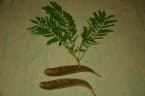
Cultivation Details
A plant of the humid and subhumid tropics[2]. It grows best in areas where the mean annual temperature is within the range 24 - 30°c, but can tolerate 18 - 34°c[2]. It prefers a mean annual rainfall in the range 1,800 - 2,200mm, tolerating 1,000 - 2,700mm[2]. Succeeds in full sun and in light shade[2]. Prefers a deep, moderately fertile medium soil[2]. Tolerant of some water-logging[3]. Prefers a pH in the range 4.5 - 5.5, but tolerates 4 - 6.5[2]. Seedling trees can reach a height of 1.5 metres by the end of their first year[3]. The trees start to produce beans from their tenth year and will continue to bear regularly[2]. After about 2-years growth in the forest, the trees become relatively fire resistant and resprout readily when lopped[3]. Trees coppice well and often produce watershoots around their base[4]. There are conflicting reports on whether or not this tree has a symbiotic relationship with certain soil bacteria, so it is unclear as to whether this tree fixes atmospheric nitrogen[5].
Propagation
Seed - best sown as soon as it is ripe because it has a short viability[3]. Storage at 15°c can extend longevity for about three months[3]. Scarifying the seed and then soaking for 24 hours in warm water prior to sowing increases the germination rate and reduces the time taken to germinate[3]. About 87% of treated seed germinates within 14 - 16 days[6]. Adult trees can be air layered[3]. Cuttings of juvenile plants can be rooted, but usually require rooting hormone[3]. Cite as: Tropical Plants Database, Ken Fern. tropical.theferns.info. 2026-02-20. <tropical.theferns.info/viewtropical.php?id=Pentaclethra+macrophylla>
Pollinators
Bees
References
- [1]Mansfeld's Database of Agricultural and Horticultural Plants — http://mansfeld.ipk-gatersleben.de/pls/htmldb_pgrc/f?p=185:3:4292127278597336 ↩︎Terse details of a huge range of useful plants.
- [2]Ecocrop — http://ecocrop.fao.org/ecocrop/srv/en/home ↩︎Basic information on a wide range of useful plants, plus details of environmental needs where available.
- [3]Forest, Farm, and Community Tree Network — http://www.winrock.org/fnrm/factnet/factnet.htm ↩︎A series of in-depth factsheets on a wide range of plants, especially leguminous trees.
- [4]Protabase - Plant Resources of Tropical Africa. — http://www.prota.org ↩︎An excellent on-line database with detailed information on over 3,200 species of useful plants of Africa.
- [5]Nodulation Plants in GRIN Taxonomy — United States Department of Agriculture · http://www.ars-grin.gov/~sbmljw/cgi-bin/taxnodul.pl?language=en ↩︎An online database listing plants that have either positive or negative reports on root and stem nodulation with nitrogen-fixing bacteria.
- [6]World Agroforesty Centre — http://www.worldagroforestry.org/ ↩︎An excellent online database of a huge range of trees giving very good information on each plant - its uses, ecology, identity, propagation, pests etc.
- [7]Dictionary of Economic Plants. — Uphof. J. C. Th. · Weinheim · 1959 · ISBN - ↩︎An excellent and very comprehensive guide but it only gives very short descriptions of the uses without any details of how to utilize the plants. Not for the casual reader.