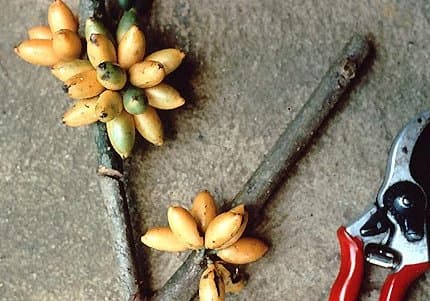
Cultivation Details
The plant thrives under a moist equatorial climate, with a mean minimum temperature of 20°c and a mean maximum temperature of 29°c. The mean annual rainfall in its area of distribution is about 1,800mm[1]. Found in the wild in sandy to rocky soils[1]. A dioecious species, both male and female forms need to be grown if fruit and seed are required[1].
Propagation
Seed - it has a hard seedcoat and may benefit from scarification before sowing in order to speed up and improve germination. This can usually be done by pouring a small amount of nearly boiling water on the seeds (being careful not to cook them!) and then soaking them for 12 - 24 hours in warm water. By this time they should have imbibed moisture and swollen - if they have not, then carefully make a nick in the seedcoat (being careful not to damage the embryo) and soak for a further 12 hours before sowing[1, PFAF]. Cite as: Tropical Plants Database, Ken Fern. tropical.theferns.info. 2026-02-20. <tropical.theferns.info/viewtropical.php?id=Penianthus+longifolius>
Pollinators
Data unavailable