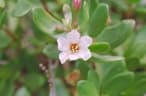
Lythraceae FAMILY Least Concern
Pemphis acidula
Pemphis acidula
Edibility
2/5
Medicinal
2/5
Safety & Hazards
None known
Cultivation Details
HabitEvergreen Shrub
GrowthFast
This species is beneficial for shoreline protection against high wind. It is a very sturdy and resilient plant, however, it will not grow anywhere other than the appropriate habitat type[1]. The tree has the ability to grow fast and can generate new roots and buds very quickly Plants usually start flowering and producing seed when about 1 - 4 metres tall[2].
Propagation
Seed - Cite as: Tropical Plants Database, Ken Fern. tropical.theferns.info. 2026-02-20. <tropical.theferns.info/viewtropical.php?id=Pemphis+acidula>
Pollinators
Data unavailable
References
- [1]IUCN Red List of Threatened Species — http://www.iucnredlist.org/ ↩︎A list of plants under threat and facing possible extinction, usually with brief details of the threats and information on habitat.
- [2]Australian Tropical Rainforest Plants — http://www.anbg.gov.au/cpbr/cd-keys/rfk/index.html ↩︎An online resource giving botanical information, and a little bit about plant usage, for over 2,700 species of plants found in the Australian rainforest.
- [3]Flora of China — Missouri Botanical Garden Press; St. Louis. · 1994 · http://flora.huh.harvard.edu/china/ ↩︎An excellent, comprehensive resource in 25 volumes. In addition to the botanical information the flora also gives basic information on habitat and some uses. An on-line version is also available.
- [4]African Flowering Plants Database — Conservatoire et Jardin Botaniques. · http://www.ville-ge.ch/musinfo/bd/cjb/africa/recherche.php ↩︎Contains information on over 150,000 plant names (including synonyms) giving a description and habitat, plus a distribution map.
- [5]Protabase - Plant Resources of Tropical Africa. — http://www.prota.org ↩︎An excellent on-line database with detailed information on over 3,200 species of useful plants of Africa.
- [6]Agroforestry in the Pacific Islands: Systems for Sustainability — W.C. Clarke and R.R. Thaman (Editors) · United Nations University Press, Tokyo · 1993 · http://www.unu.edu/unupress/unupbooks/80824e/80824E00.htm#Contents · ISBN 92-808-0824-9 ↩︎The guide includes information on 100 species of plants for Agroforestry. It is also available on the web at the address given above.
- [7]Sturtevant's Edible Plants of the World. — Hedrick. U. P. · Dover Publications · 1972 · ISBN 0-486-20459-6 ↩︎Lots of entries, quite a lot of information in most entries and references.
- [8]The Standard Cyclopedia of Horticulture (6 volumes) — Bailey L.H. · The MacMillan Company, Toronto. · 1919 · http://www.biodiversitylibrary.org/ ↩︎Rather dated, but it still contains a wealth of useful information. It can be downloaded from the internet.
- [9]Journal of Ethnopharmacology. Vol. 37, pp179 - 196 — Bourdy. G. & Walter. A. · Elsevier Scientific Publishers; Ireland. · 1992 ↩︎Information on various herbs used to facilitate childbirth in Vanuatu. Available to download as a PDF document from the Internet.
- [10]Dictionary of Economic Plants. — Uphof. J. C. Th. · Weinheim · 1959 · ISBN - ↩︎An excellent and very comprehensive guide but it only gives very short descriptions of the uses without any details of how to utilize the plants. Not for the casual reader.
- [11]The Useful Plants of the Island of Guam — Safford W.E. · Smithsonian Institute; Washington. · 1905 · http://www.biodiversitylibrary.org/ ↩︎A very comprehensive, if rather dated, guide to the plants of Guam. It can be downloaded from the Internet.