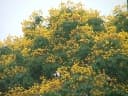
Peltophorum pterocarpum
Peltophorum pterocarpum
Safety & Hazards
None known
Cultivation Details
A plant of the moist to wet tropics, where it is usually found at elevations below 100 metres but can occasionally be found up to 1,600 metres[1]. It grows best in areas where annual daytime temperatures are within the range 27 - 36°c, but can tolerate 10 - 40°c[2]. Plants have been known to survive occasional low temperatures down to -5°c[3]. It prefers a mean annual rainfall in the range 1,200 - 1,800mm, but tolerates 1,000 - 4,000mm[2]. It thrives best under more or less seasonal conditions with a dry season of 1 - 3 months[1]. Grows best in a sunny position[2]. The tree prefers light to medium free draining alkaline soils although it also tolerates clay soils[1]. Plants can tolerate moderate levels of salt in the soil[2]. Prefers a pH in the range 5 - 6.5, tolerating 4.3 - 7.3[2]. A fast-growing tree, attaining a height of 9 metres in 3 years and flowering when around 4 years old[1]. Agroforestry trials in south Sumatra with hedgerows spaced at 4 metre intervals and cut 2 - 4 times a year indicated that, over a 3-year period, an average pruning yield of 8 tons/ha was possible[1]. The umbrella-shaped crowns which developed following cutting allowed little light to reach the ground[1]. After the first year of establishment, little effort is needed to maintain plantations[1]. Stands will usually survive, even with thick ground cover, such as Imperata or other tall grasses[1]. The tree has a deep root system[1]. This species has a symbiotic relationship with certain soil bacteria, these bacteria form nodules on the roots and fix atmospheric nitrogen. Some of this nitrogen is utilized by the growing plant but some can also be used by other plants growing nearby[3].
Propagation
Seed. Untreated seeds need several months to germinate[4] - germination is hastened by scarifying one end of the hard seed coat, softening the seed coat in dilute acid, or immersing the seed in boiling water for 2 minutes followed by soaking it in cold water for one night[1]. Germination has been recorded at 78%[1]. Seedlings are best raised in the nursery for one year before transplanting to the field[1]. Grafts or cuttings may be used to obtain better uniformity for roadside trees. Wildings have also been successfully used for planting[1]. Cite as: Tropical Plants Database, Ken Fern. tropical.theferns.info. 2026-02-20. <tropical.theferns.info/viewtropical.php?id=Peltophorum+pterocarpum>
Pollinators
Data unavailable
References
- [1]World Agroforesty Centre — http://www.worldagroforestry.org/ ↩︎An excellent online database of a huge range of trees giving very good information on each plant - its uses, ecology, identity, propagation, pests etc.
- [2]Ecocrop — http://ecocrop.fao.org/ecocrop/srv/en/home ↩︎Basic information on a wide range of useful plants, plus details of environmental needs where available.
- [3]The New RHS Dictionary of Gardening. 1992. — Huxley. A. · MacMillan Press · 1992 · ISBN 0-333-47494-5 ↩︎Excellent and very comprehensive, though it contains a number of silly mistakes. Readable yet also very detailed.
- [4]Plant Resources of Southeast Asia — http://proseanet.org/ ↩︎Lots of information on the uses of the plants of SE Asia.
- [5]Mansfeld's Database of Agricultural and Horticultural Plants — http://mansfeld.ipk-gatersleben.de/pls/htmldb_pgrc/f?p=185:3:4292127278597336 ↩︎Terse details of a huge range of useful plants.