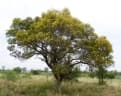
Peltophorum africanum
Peltophorum africanum
Safety & Hazards
The gum is reputed to be poisonous[1].
Cultivation Details
A plant of the moist lowland tropics and subtropics, where it is found at elevations up to 1,000 metres. It grows best in areas where annual daytime temperatures are within the range 20 - 32°c, but can tolerate 16 - 38°c[1]. When dormant, the plant can survive temperatures down to about -4°c, but young growth can be severely damaged at -1°c[1]. It prefers a mean annual rainfall in the range 1,000 - 2,500mm, but tolerates 700 - 3,000mm[1]. Grows best in a sunny position[1]. Prefers a well-drained, sandy to loamy soil of moderate fertility[1]. The plant is encountered in the wild on very poor, acidic, sandy, loamy to gravelly soil derived from sandstone, quartzite or shale and is also found on shallow soils on norite, granite and laterite[2]. Prefers a pH in the range 5.5 - 7, tolerating 5 - 7.5[1]. Established plants are drought tolerant[1]. A fast growing tree[1]. The initial growth rate is 1 - 1.5 metres per year[1]. After cutting the tree coppices readily. Increased cutting height has a strong positive effect on the number of new shoots[2]. Although many species within the family Fabaceae have a symbiotic relationship with soil bacteria, this species is said to be devoid of such a relationship and therefore does not fix atmospheric nitrogen[2].
Propagation
Seed - it has a hard seedcoat and may benefit from scarification before sowing to speed up germination. This can usually be done by pouring a small amount of nearly boiling water on the seeds (being careful not to cook them!) and then soaking them for 12 - 24 hours in warm water. By this time they should have imbibed moisture and swollen - if they have not, then carefully make a nick in the seedcoat (being careful not to damage the embryo) and soak for a further 12 hours before sowing. The seeds take 3 - 10 days to germinate and the germination percentage is usually high[2]. Young plants transplant readily, are fairly fast growing, but need protection from frost for 2 - 3 years although they withstand slight frost[2]. The seed stores well, viability is maintained after 3 years of hermetic storage at room temperature[2]. Cite as: Tropical Plants Database, Ken Fern. tropical.theferns.info. 2026-02-20. <tropical.theferns.info/viewtropical.php?id=Peltophorum+africanum>
Pollinators
Bees
References
- [1]Ecocrop — http://ecocrop.fao.org/ecocrop/srv/en/home ↩︎Basic information on a wide range of useful plants, plus details of environmental needs where available.
- [2]Protabase - Plant Resources of Tropical Africa. — http://www.prota.org ↩︎An excellent on-line database with detailed information on over 3,200 species of useful plants of Africa.
- [3]Gemsbok Bean and Kalahari Truffle — Leffers A. · Gamsberg MacMillan; Namibia. · 2003 · ISBN 99916-0-491-X ↩︎Details of the traditional uses of over 200 species of plants in northeastern Namibia. Written for the non-expert, there is usually at least one photograph with each plant entry.