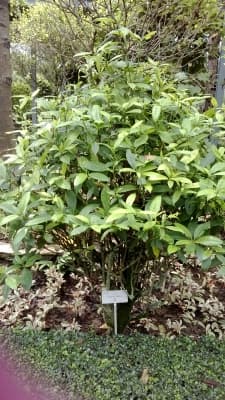
Pavetta indica
Pavetta indica
Safety & Hazards
None known
Cultivation Details
Grows best in a sunny position, preferring a humus-rich, well-drained soil[1]. Many Pavetta species, including this one, produce leaves with bacterial nodes - these bacteria live in symbiosis with the plant and pass into any seeds that are produced, thus seedlings are already inocculated with the bacteria[2]. It is not certain what function the bacteria play, theories include nitrogen-fixation, growth-regulation and making the leaves poisonous to livestock[3]. Pavetta indica is confined to India and Sri Lanka - there are several closely related species in other areas formerly considered its range, from southern China through southeast Asia to Australia. In Java, there are Pavetta axillaris Bremek.; Pavetta montana Reinw. Ex Blume; Pavetta reinwardtii Bremek.; Pavetta subvelutina Miq.; and Pavetta sylvatica Blume. Plants from China, previously treated as Pavetta indica, belong to the species Pavetta hongkongensis Bremek.[4].
Propagation
Seed - Cuttings of half-ripe wood taken at a node. Air-layering. Cite as: Tropical Plants Database, Ken Fern. tropical.theferns.info. 2026-02-20. <tropical.theferns.info/viewtropical.php?id=Pavetta+indica>
Pollinators
Lepidoptera
References
- [1]Encyclopedia of Tropical Plants - Identification and Cultivation of over 3,000 Tropical Plants — Ahmed Fayaz · Firefly Books Ltd.; New Zealand · 2011 · ISBN 978-1-55407-489 ↩︎A good photograph and terse but detailed information for over 3,000 species of tropical plants. An excellent reference.
- [2]Plant Resources of Southeast Asia — http://proseanet.org/ ↩︎Lots of information on the uses of the plants of SE Asia.
- [3]PlantZAfrica.com — http://www.plantzafrica.com ↩︎An excellent site giving detailed descriptions and uses of many S. African plants.
- [4]Flora of China — Missouri Botanical Garden Press; St. Louis. · 1994 · http://flora.huh.harvard.edu/china/ ↩︎An excellent, comprehensive resource in 25 volumes. In addition to the botanical information the flora also gives basic information on habitat and some uses. An on-line version is also available.
- [5]Philippine Medicinal Plants — http://www.stuartxchange.org/CompleteList.html ↩︎A lovely site, giving brief details on the medicinal uses of several hundred (over 400 at the last count) plants in the Philippines, plus a picture of each plant.
- [PFAF]Plants for a Future — pfaf.org ↩︎