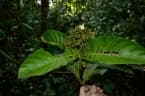
Pausinystalia johimbe
Pausinystalia johimbe
Safety & Hazards
The bark contains alkaloids that have medical applications at low doses but are toxic at larger doses[1]. Poisonous doses of the bark are reported to paralyze respiration and the drug can cause severe hypotension, abdominal distress and weakness[2]. The bark can also be used as a fish poison[2].
Cultivation Details
A plant of the humid, lowland tropics, where it is found at elevations up to 500 metres[2]. It grows best in areas where the mean annual temperature ranges between 22 - 28°c, but can succeed at 18 - 35°c[2]. It prefers a mean annual rainfall in the range of 2,000 - 4,000mm, but tolerates from 1,500 - 5,000mm[2]. Succeeds in full sun and in partial shade[2]. Grows best in a fertile, moist but well-drained, medium to heavy soil with high humidity[3, 2]. Prefers a pH in the range 5.5 - 7, but can tolerate 5 - 7.5[2]. A fast growing tree but the bole never reaches a great diameter[4]. The species coppices well, producing strong, highly phototrophic shoots[4]. The bark is harvested as the source of the alkaloid yohimbine. The main stem gives the best material but is not rich in alkaloids until the tree is 15 - 20 years of age, by which time it can contain 2 - 15% yohimbine. Bark exploitation is a seasonal activity as the yohimbine levels are highest during the rainy season[4]. Although the trees callus well after a small amount of bark removal, removal of large quantities of bark can lead to an attack by a small stem borer which penetrates the unprotected stem, killing the tree[4].
Propagation
Seed - Cite as: Tropical Plants Database, Ken Fern. tropical.theferns.info. 2026-02-20. <tropical.theferns.info/viewtropical.php?id=Pausinystalia+johimbe>
Pollinators
Data unavailable
References
- [1]The Encyclopedia of Medicinal Plants — Chevallier. A. · Dorling Kindersley. London · 1996 · ISBN 9-780751-303148 ↩︎An excellent guide to over 500 of the more well known medicinal herbs from around the world.
- [2]Ecocrop — http://ecocrop.fao.org/ecocrop/srv/en/home ↩︎Basic information on a wide range of useful plants, plus details of environmental needs where available.
- [3]Encyclopaedia of Herbs and their Uses. — Bown. D. · Dorling Kindersley, London. · 1995 · ISBN 0-7513-020-31 ↩︎A very well presented and informative book on herbs from around the globe. Plenty in it for both the casual reader and the serious student. Just one main quibble is the silly way of having two separate entries for each plant.
- [4]World Agroforesty Centre — http://www.worldagroforestry.org/ ↩︎An excellent online database of a huge range of trees giving very good information on each plant - its uses, ecology, identity, propagation, pests etc.
- [5]The Useful Plants of West Tropical Africa. — Burkil. H. M. · Royal Botanic Gardens; Kew. · 1985 - 2004 ↩︎Brief descriptions and details of the uses of over 4,000 plants. A superb, if terse, resource, it is also available electronically on the Web - see http://www.aluka.org/