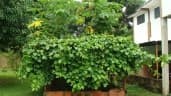
Passiflora quadrangularis
Passiflora quadrangularis
Cultivation Details
Succeeds in the hot, wet, lowlands to moderate elevations in tropical to subtropical climates[1, 3]. Grows better at elevations between 200 - 500 metres[4]. Plants require a temperature no lower than around 16°c when they are flowering in order to ensure fruit set[5]. They can be damaged if temperatures fall much below 10°c[1]. Requires a humus-rich, moist but well-drained soil and a position in dappled shade where it can grow up towards the sun[1]. Prefers a circumneutral soil, disliking very acid or very alkaline conditions[1]. Passiflora species tend to flower and fruit more freely when grown in soils of only moderate fertility[5]. Seedling plants can commence fruiting when only 1 - 2 years old, whilst cuttings have been known to fruit in their first year of growth[3]. Plants can flower and fruit all year round[1]. A self-sterile species[5]. Plants are very tolerant of pruning and can be cut back to ground level if required to rejuvenate the plant[6]. Plants in this genus are notably resistant to honey fungus[5].
Propagation
Seed - best sown as soon as it is ripe along with the pulp which will help break down the seed coat and speed up germination[1]. Stored seed should be soaked for 24 hours in warm water and germination time can be reduced if the seed is then mixed with the juice of a fresh passion fruit (of any species)[1]. Even so, it can take 12 months for stored seed to germinate[1]. Place the seed tray in a shady position, maintaining a temperature around 19 - 24°c[1]. Prick the seedlings out into individual containers as soon as they are large enough to handle and plant out when large enough[1]. Cuttings of young shoots, taken at the nodes. The cuttings root best in a neutral to slightly acid compost, but 100% sharp sand also produces good results[1]. Cuttings of fully mature wood taken at a node. They can take 3 months, but there is usually a high percentage[7]. Layering. Very easy[1]. Air layering. Cite as: Tropical Plants Database, Ken Fern. tropical.theferns.info. 2026-02-20. <tropical.theferns.info/viewtropical.php?id=Passiflora+quadrangularis>
Pollinators
Data unavailable
References
- [1]Passion Flowers — Vanderplank. J. · Cassell. London. · 1991 · ISBN 0-304-34076-6 ↩︎An excellent book on passion flowers, giving information on hardy species and how to grow the less hardy in greenhouses etc. A bit lacking at times on specific information on hardyness. Excellent photographs.
- [2]Medicinal Plants of the Guianas — DeFilipps, R. A.; Maina, S. L.; & Crepin, J. · Smithsonian Museum · http://botany.si.edu/bdg/medicinal/index.html ↩︎A down-loadable PDF document of a book in pre-publication awaiting illustration. An excellent, if rather terse, guide to the traditional medicinal uses of the plants of the region
- [3]Perennial Edible Fruits of the Tropics : an Inventory — Martin, F. W.; Campbell, C. W.; Rubertbe, R. M. · U.S. Dept. of Agriculture, Agricultural Research Service · 1987 ↩︎A booklet giving terse details of almost 300 species of edible fruits, plus regional lists of Botanical and Common names for over 2,500 less well-known edible fruits of the tropics.
- [4]Plant Resources of Southeast Asia — http://proseanet.org/ ↩︎Lots of information on the uses of the plants of SE Asia.
- [5]The New RHS Dictionary of Gardening. 1992. — Huxley. A. · MacMillan Press · 1992 · ISBN 0-333-47494-5 ↩︎Excellent and very comprehensive, though it contains a number of silly mistakes. Readable yet also very detailed.
- [6]Climbers and Wall Shrubs. — Davis. B. · Viking. · 1990 · ISBN 0-670-82929-3 ↩︎Contains information on 2,000 species and cultivars, giving details of cultivation requirements. The text is terse but informative.
- [7]Growing Unusual Fruit. — Simmons. A. E. · David & Charles; Newton Abbot. · 1972 · ISBN 0-7153-5531-7 ↩︎A very readable book with information on about 100 species that can be grown in Britain (some in greenhouses) and details on how to grow and use them.
- [8]Brazilian Fruits and Cultivated Exotics — Lorenzi. H.; Bacher. L.; Lacerda. M.; Sartori. S. · Instituto Plantarum De Estudos Da Flora LTDA; Brazil. · 2000 · ISBN 85-867174-24-0 ↩︎A superb book, giving information on several hundred fruit species. Each entry has a brief description of the plant and its uses, accompanied by one to many excellent quality photographs of the fruits.
- [9]Cornucopia II — Facciola. S. · Kampong Publications, California. · 1998 · ISBN 0-9628087-2-5 ↩︎The second edition of an excellent guide to the edible uses of plants, though it does not give any details of cultivation etc.
- [10]Mansfeld's Database of Agricultural and Horticultural Plants — http://mansfeld.ipk-gatersleben.de/pls/htmldb_pgrc/f?p=185:3:4292127278597336 ↩︎Terse details of a huge range of useful plants.
- [11]Passifloraceae — MacDougal J.M. · 2011 ↩︎
- [12]Dictionary of Economic Plants. — Uphof. J. C. Th. · Weinheim · 1959 · ISBN - ↩︎An excellent and very comprehensive guide but it only gives very short descriptions of the uses without any details of how to utilize the plants. Not for the casual reader.
- [13]Tropical Food Gardens — Norrington. L. · Bloomings Books (Melbourne) · 2001 · ISBN 1-876473-41-x ↩︎Excellent little book giving some basic information on a range of plants.
- [14]Passifloraceae do Brasil. Estudo do gênero Passiflora L., subgênero Passiflora — Cervi A.C. · 1997 · ISBN 0212-0623 ↩︎
- [15]CosIng — http://ec.europa.eu/growth/tools-databases/cosing/ ↩︎CosIng is the European Commission database for information on cosmetic substances and ingredients.