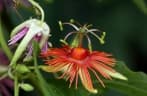
Passiflora jorullensis
Passiflora jorullensis
Safety & Hazards
None known
Cultivation Details
Passiflora species generally grow best in a sheltered, sunny position or in dappled shade. Most species are found in the wild in moist but well-drained soils, generally of a lighter texture, and will often flower and fruit more heavily if the soil fertility is low. They often develop deep roots and can be moderately tolerant of dry spells. Most Passiflora species prefer a neutral to slightly alkaline soil, growing best where the pH is around 6. 5 - 7.5[1, 2]. Unlike most other Passiflora, the flowers of this species last for two days rather than one.
Propagation
Seed - best sown as soon as it is ripe along with the pulp which will help break down the seed coat and speed up germination[2]. Stored seed should be soaked for 24 hours in warm water and germination time can be reduced if the seed is then mixed with the juice of a fresh passion fruit (of any species)[2]. Even so, it can take 12 months for stored seed to germinate[2]. Place the seed tray in a shady position, maintaining a temperature around 19 - 24°c[2]. Prick the seedlings out into individual containers as soon as they are large enough to handle and plant out when large enough[2]. Cuttings of young shoots, taken at the nodes. The cuttings root best in a neutral to slightly acid compost, but 100% sharp sand also produces good results[2]. Cuttings of fully mature wood taken at a node. They can take 3 months[3]. Layering. Very easy[2]. Air layering. Cite as: Tropical Plants Database, Ken Fern. tropical.theferns.info. 2026-02-20. <tropical.theferns.info/viewtropical.php?id=Passiflora+jorullensis>
Pollinators
Wasps, hummingbirds
References
- [1]The New RHS Dictionary of Gardening. 1992. — Huxley. A. · MacMillan Press · 1992 · ISBN 0-333-47494-5 ↩︎Excellent and very comprehensive, though it contains a number of silly mistakes. Readable yet also very detailed.
- [2]Passion Flowers — Vanderplank. J. · Cassell. London. · 1991 · ISBN 0-304-34076-6 ↩︎An excellent book on passion flowers, giving information on hardy species and how to grow the less hardy in greenhouses etc. A bit lacking at times on specific information on hardyness. Excellent photographs.
- [3]Growing Unusual Fruit. — Simmons. A. E. · David & Charles; Newton Abbot. · 1972 · ISBN 0-7153-5531-7 ↩︎A very readable book with information on about 100 species that can be grown in Britain (some in greenhouses) and details on how to grow and use them.
- [4]Passifloraceae — MacDougal J.M. · 2011 ↩︎
- [5]Flora of Guatemala — Standley P.C. & J. A. Steyermark · 1946 - 1976 · http://www.archive.org/ ↩︎A superb reference, though somewhat dated. Gives lots of plant uses as well as information on plant habit and habitat. The entire flora (13 volumes) can now be downloaded from http://www.archive.org/
- [6]Dictionary of Economic Plants. — Uphof. J. C. Th. · Weinheim · 1959 · ISBN - ↩︎An excellent and very comprehensive guide but it only gives very short descriptions of the uses without any details of how to utilize the plants. Not for the casual reader.
- [7]Dicionário das Plantas Úteis do Basil e das Exóticas Cultivadas Vol. 5 — Corrêa M. Pio & Penna L. de Azeredo · Ministério da Agricultura; Rio de Janeiro · 1978 ↩︎A massive work in six volumes, first published in the 1920's and revised in the 1970's. Written in Portuguese.
- [PFAF]Plants for a Future — pfaf.org ↩︎