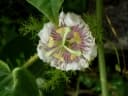
Cultivation Details
Passiflora foetida is found from the warm temperate zone to the tropics of North and South America. Plants are not very tolerant of frost, and can be killed by temperatures falling to around 3°c. They require a temperature no lower than around 16°c when they are flowering in order to ensure fruit set[4]. Requires a humus-rich, moist but well-drained soil and a position in dappled shade[1]. Prefers a circumneutral soil, disliking very acid or very alkaline conditions[1]. Passiflora species tend to flower and fruit more freely when grown in soils of only moderate fertility[4]. This species is considered to be a weed in many parts of the tropics[1]. Dormant seeds can remain viable for many years in the soil[3]. The plant can flower and produce fruit all year round[5]. An extremely variable and widespread plant, it has a very long list of synonyms[1]. Plants are very tolerant of pruning and can be cut back to ground level if required to rejuvenate the plant[6]. Plants in this genus are notably resistant to honey fungus[4].
Propagation
Pre-soak the seed for 12 hours in warm water and then sow late winter or early spring in a warm greenhouse. If sown in January and grown on fast it can flower and fruit in its first year[7]. The seed germinates in 1 - 12 months at 20°c. Prick out the seedlings into individual pots when they are large enough to handle. It you are intending to grow the plants outdoors, it is probably best to keep them in the greenhouse for their first winter and plant them out into their permanent positions in late spring or early summer, after the last expected frosts. Mulch the roots well in late autumn to protect them from the cold. Cuttings of young shoots, 15cm with a heel, in spring[8]. Leaf bud cuttings in spring. Cuttings of fully mature wood in early summer. Takes 3 months. High percentage[9]. Cite as: Temperate Plants Database, Ken Fern. temperate.theferns.info. 2026-02-21. <temperate.theferns.info/plant/Passiflora+foetida>
Pollinators
Bees, Self
References
- [1]Passion Flowers — Vanderplank. J. · Cassell. London. · 1991 · ISBN 0-304-34076-6 ↩︎An excellent book on passion flowers, giving information on hardy species and how to grow the less hardy in greenhouses etc. A bit lacking at times on specific information on hardyness. Excellent photographs.
- [2]Mansfeld's Database of Agricultural and Horticultural Plants — http://mansfeld.ipk-gatersleben.de/pls/htmldb_pgrc/f?p=185:3:4292127278597336 ↩︎Terse details of a huge range of useful plants.
- [3]Invasive Species Compendium — http://www.cabi.org ↩︎An immense resource - in depth information on over 900 species of invasive plants (it also has information on animals, fungi etc).
- [4]The New RHS Dictionary of Gardening. 1992. — Huxley. A. · MacMillan Press · 1992 · ISBN 0-333-47494-5 ↩︎Excellent and very comprehensive, though it contains a number of silly mistakes. Readable yet also very detailed.
- [5]Medicinal Plants in Papua New Guinea — World Health Organisation · 2009 · ISBN 978-92-9061-249-0 ↩︎Traditional medicinal uses of 126 species from Papua New Guinea, including information on modern research into the plants.
- [6]Climbers and Wall Shrubs. — Davis. B. · Viking. · 1990 · ISBN 0-670-82929-3 ↩︎Contains information on 2,000 species and cultivars, giving details of cultivation requirements. The text is terse but informative.
- [7]The Garden. Volume 112. — RHS. · Royal Horticultural Society · 1987 · ISBN - ↩︎Snippets of information from the magazine of the RHS. In particular, there are articles on plants that are resistant to honey fungus, oriental vegetables, Cimicifuga spp, Passiflora species and Cucurbits.
- [8]RHS Dictionary of Plants plus Supplement. 1956 — F. Chittendon. · Oxford University Press · 1951 · ISBN - ↩︎Comprehensive listing of species and how to grow them. Somewhat outdated, it has been replaced in 1992 by a new dictionary (see [ 200 ]).
- [9]Growing Unusual Fruit. — Simmons. A. E. · David & Charles; Newton Abbot. · 1972 · ISBN 0-7153-5531-7 ↩︎A very readable book with information on about 100 species that can be grown in Britain (some in greenhouses) and details on how to grow and use them.
- [10]Fruits of the Guianan Flora — van Roosmalen. M.G.M. · Institute of Systematic Boyany, Utrecht University; Netherlands. · 1985 · ISBN 90-9000988-4 ↩︎Terse descriptions of over 1,700 species from the Guianas that bear fruits - not necessarily edible! Often mentions if the fruit is edible, plus gives brief description of habit and habitat.
- [11]Passifloraceae — MacDougal J.M. · 2011 ↩︎
- [12]Brazilian Fruits and Cultivated Exotics — Lorenzi. H.; Bacher. L.; Lacerda. M.; Sartori. S. · Instituto Plantarum De Estudos Da Flora LTDA; Brazil. · 2000 · ISBN 85-867174-24-0 ↩︎A superb book, giving information on several hundred fruit species. Each entry has a brief description of the plant and its uses, accompanied by one to many excellent quality photographs of the fruits.
- [13]Flowering Plants of Jamaica — Adams. C.D. · University of the West Indies; Jamaica. · 1972 ↩︎A terse treatment of the flowering plants of Jamaica, with a botanical description of each plant, notes on habitat etc.
- [14]Medicinal Plants in the South Pacific — WHO Regional Publications, Manilla. · 1998 · ISBN 92-9061-118-9 ↩︎Excellent guide to 102 medicinal herbs of the Pacific Islands, with photographs of each plant and details of their constituents, biological activities and traditional uses. A description of each plant, together with habitat and distribution is given.
- [15]Food Plants in the Americas: A Survey of the Domesticated, Cultivated, and Wild Plants Used for Human Food in North, — Kermath B.M.; Bennett B.C.' Pulsipher L.M. · 2014 ↩︎A pre-publication draft of an amazing, on-going work first started in 1985. It contains information on more than 3,900 taxa from the Americas - from Arctic regions to the Tropics
- [16]Traditional Vegetables in Benin — Achigan-Dako E. Et al · Darwin Initiative; International Foundation for Science · 2009 ↩︎Issued as a PDF on the Internet, it contains basic information on over 250 species of plants used for food in Benin.
- [17]Medicinal Plants of the Guianas — DeFilipps, R. A.; Maina, S. L.; & Crepin, J. · Smithsonian Museum · http://botany.si.edu/bdg/medicinal/index.html ↩︎A down-loadable PDF document of a book in pre-publication awaiting illustration. An excellent, if rather terse, guide to the traditional medicinal uses of the plants of the region
- [18]Medicinal Plants in Vietnam — Nguyen Van Dan & Doan Thi Nhu · World Health Organisation · 1989 · ISBN 92 9061 101 4 ↩︎An excellent book, giving information on over 200 plants, their medicinal compounds and applications.