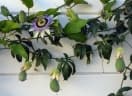
Passiflora caerulea
Passiflora caerulea
Safety & Hazards
None known
Cultivation Details
Passiflora caerulea is a plant of the subtropical to tropical zones of South America, usually growing at elevations above about 500 metres in the tropics. Dormant plants are hardy to about -15°c, if they are cut down to the ground by frost then they will usually regenerate from the base[1]. Requires a well-drained soil with plenty of moisture in the growing season, otherwise it is not fussy[2, 1]. Dislikes highly alkaline soils[3]. Passiflora species tend to flower and fruit more freely when grown in soils of only moderate fertility[1]. A very fast growing plant[4]. Roots of outdoor grown plants should be restricted to encourage fruiting[2]. Plants can flower and fruit in their first year from seed[5]. The plant has a very long flowering period, from early summer to early autumn, though individual flowers only live for about 48 hours[6]. The flowers are open all night and start to close in the morning[7]. The flowers are delicately scented[6]. The cultivar 'Constance Elliot' is more fragrant[6]. If fruit is required, especially when the plant is grown indoors, it is best to hand pollinate using pollen from a flower that has been open for 12 hours to pollinate a newly opened flower before midday[5, 1]. The flowers open in sunny weather and do not open on dull cloudy days[8]. Plants are very tolerant of pruning and can be cut back to ground level if required to rejuvenate the plant[3]. Any pruning is best carried out in the spring[8]. Plants in this genus are notably resistant to honey fungus[1].
Propagation
Pre-soak the seed for 12 hours in warm water and then sow late winter or early spring in a warm greenhouse. If sown in January and grown on fast it can flower and fruit in its first year[5]. The seed germinates in 1 - 12 months at 20°c. Prick out the seedlings into individual pots when they are large enough to handle. It you are intending to grow the plants outdoors, it is probably best to keep them in the greenhouse for their first winter and plant them out into their permanent positions in late spring or early summer, after the last expected frosts. Mulch the roots well in late autumn to protect them from the cold. Cuttings of young shoots, 15cm with a heel, in spring[2]. Leaf bud cuttings in spring. Cuttings of fully mature wood in early summer. Takes 3 months. High percentage[9]. Cite as: Temperate Plants Database, Ken Fern. temperate.theferns.info. 2026-02-21. <temperate.theferns.info/plant/Passiflora+caerulea>
Pollinators
Bees
References
- [1]The New RHS Dictionary of Gardening. 1992. — Huxley. A. · MacMillan Press · 1992 · ISBN 0-333-47494-5 ↩︎Excellent and very comprehensive, though it contains a number of silly mistakes. Readable yet also very detailed.
- [2]RHS Dictionary of Plants plus Supplement. 1956 — F. Chittendon. · Oxford University Press · 1951 · ISBN - ↩︎Comprehensive listing of species and how to grow them. Somewhat outdated, it has been replaced in 1992 by a new dictionary (see [ 200 ]).
- [3]Climbers and Wall Shrubs. — Davis. B. · Viking. · 1990 · ISBN 0-670-82929-3 ↩︎Contains information on 2,000 species and cultivars, giving details of cultivation requirements. The text is terse but informative.
- [4]Trees and Shrubs Hardy in Great Britain. Vol 1 - 4 and Supplement. — Bean. W. · Murray · 1981 · ISBN - ↩︎A classic with a wealth of information on the plants, but poor on pictures.
- [5]The Garden. Volume 112. — RHS. · Royal Horticultural Society · 1987 · ISBN - ↩︎Snippets of information from the magazine of the RHS. In particular, there are articles on plants that are resistant to honey fungus, oriental vegetables, Cimicifuga spp, Passiflora species and Cucurbits.
- [6]Scented Flora of the World. — Genders. R. · Robert Hale. London. · 1994 · ISBN 0-7090-5440-8 ↩︎An excellent, comprehensive book on scented plants giving a few other plant uses and brief cultivation details. There are no illustrations.
- [7]Conservatory and Indoor Plants Volumes 1 & 2 — Phillips. R. & Rix. M. · Pan Books, London. · 1998 · ISBN 0-330-37376-5 ↩︎Excellent photos of over 1,100 species and cultivars with habits and cultivation details plus a few plant uses. Many species are too tender for outdoors in Britain though there are many that can be grown outside.
- [8]Gardening on Walls — Grey-Wilson. C. & Matthews. V. · Collins · 1983 · ISBN 0-00-219220-0 ↩︎A nice little book about plants for growing against walls and a small section on plants that can grow in walls.
- [9]Growing Unusual Fruit. — Simmons. A. E. · David & Charles; Newton Abbot. · 1972 · ISBN 0-7153-5531-7 ↩︎A very readable book with information on about 100 species that can be grown in Britain (some in greenhouses) and details on how to grow and use them.
- [10]Flora of N. America — http://flora.huh.harvard.edu/fna/ ↩︎An on-line version of the flora with an excellent description of the plant including a brief mention of plant uses.
- [11]Passifloraceae — MacDougal J.M. · 2011 ↩︎
- [12]Brazilian Fruits and Cultivated Exotics — Lorenzi. H.; Bacher. L.; Lacerda. M.; Sartori. S. · Instituto Plantarum De Estudos Da Flora LTDA; Brazil. · 2000 · ISBN 85-867174-24-0 ↩︎A superb book, giving information on several hundred fruit species. Each entry has a brief description of the plant and its uses, accompanied by one to many excellent quality photographs of the fruits.
- [13]Invasive Species Compendium — http://www.cabi.org ↩︎An immense resource - in depth information on over 900 species of invasive plants (it also has information on animals, fungi etc).
- [14]Sturtevant's Edible Plants of the World. — Hedrick. U. P. · Dover Publications · 1972 · ISBN 0-486-20459-6 ↩︎Lots of entries, quite a lot of information in most entries and references.
- [15]A Modern Herbal. — Grieve. · Penguin · 1984 · ISBN 0-14-046-440-9 ↩︎Not so modern (1930's?) but lots of information, mainly temperate plants.
- [16]Tanaka's Cyclopedia of Edible Plants of the World. — Tanaka. T. & Nakao S. · Keigaku Publishing; Tokyo · 1976 · ISBN - ↩︎The most comprehensive list of edible plants I've come across. Only the briefest entry for each species, though, and some of the entries are more than a little dubious. Not for the casual reader.
- [17]Plants for Human Consumption. — Kunkel. G. · Koeltz Scientific Books · 1984 · ISBN 3874292169 ↩︎An excellent book for the dedicated. A comprehensive listing of Latin names with a brief list of edible parts.
- [18]Cornucopia - A Source Book of Edible Plants. — Facciola. S. · Kampong Publications · 1990 · ISBN 0-9628087-0-9 ↩︎Excellent. Contains a very wide range of conventional and unconventional food plants (including tropical) and where they can be obtained (mainly N. American nurseries but also research institutes and a lot of other nurseries from around the world.
- [19]Cornucopia II — Facciola. S. · Kampong Publications, California. · 1998 · ISBN 0-9628087-2-5 ↩︎The second edition of an excellent guide to the edible uses of plants, though it does not give any details of cultivation etc.
- [20]Dicionário das Plantas Úteis do Basil e das Exóticas Cultivadas Vol. 5 — Corrêa M. Pio & Penna L. de Azeredo · Ministério da Agricultura; Rio de Janeiro · 1978 ↩︎A massive work in six volumes, first published in the 1920's and revised in the 1970's. Written in Portuguese.
- [21]CosIng — http://ec.europa.eu/growth/tools-databases/cosing/ ↩︎CosIng is the European Commission database for information on cosmetic substances and ingredients.
- [PFAF]Plants for a Future — pfaf.org ↩︎