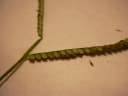
Paspalum scrobiculatum
Paspalum scrobiculatum
Safety & Hazards
There is one report that, unless special precautions are taken the seed is apt to act as a narcotic poison, producing delirium and vomiting[1]. This report is very likely to be a misidentification or a confusion with fungal infection of the seed with ergot[2, PFAF], since the plant is commonly used as a food and is reported in many other sources[3, 4, 2] as being wholesome[PFAF].
Cultivation Details
A plant of low to fairly high elevations in the tropics and subtropics, being found from sea level to 3,000 metres[5]. It grows best in areas where the mean annual temperature ranges from 25 - 27°c, also succeeding in the range 5 - 33°c[5]. It prefers a mean annual rainfall in the range 1,000 - 1,600mm, but can tolerate 800 - 4,300mm[5]. Tolerates a wide range of soils, from fertile clay loams to sandy loams, but prefers a light, moderately fertile, porous soil in full sun[6, 2]. Plants can succeed in wet soils and are tolerant of flooding[5]. Prefers a pH in the range 4.8 - 6, but can tolerate 4.3 - 8[5]. Plants spread readily by means of self-sown seedlings and can become a weed in agricultural land[2, 5]. When grown as a grain crop, the seed can be harvested after 120 - 180 days[5]. The seed ripens over a period of three to four months, the seeds fall as they mature, which makes seed harvesting difficult[2].
Propagation
Seed - it germinates best at a temperature of 20-35°c. Sow in situ on a well-prepared, very fine seedbed, only just covering the seed[2]. The seed only remains viable for 12 months[2]. Cite as: Tropical Plants Database, Ken Fern. tropical.theferns.info. 2026-02-20. <tropical.theferns.info/viewtropical.php?id=Paspalum+scrobiculatum>
Pollinators
Data unavailable
References
- [1]The Useful Plants of the Island of Guam — Safford W.E. · Smithsonian Institute; Washington. · 1905 · http://www.biodiversitylibrary.org/ ↩︎A very comprehensive, if rather dated, guide to the plants of Guam. It can be downloaded from the Internet.
- [2]Grassland Species - Profiles — http://www.fao.org/ag/AGP/AGPC/doc/Gbase/Default.htm ↩︎Terse information on over 650 species of plants that grow in grassland, including trees, shrubs and perennial plants as well as grasses. Gives a brief description of the plant, its range and habitat and some of its uses.
- [3]Flora of China — Missouri Botanical Garden Press; St. Louis. · 1994 · http://flora.huh.harvard.edu/china/ ↩︎An excellent, comprehensive resource in 25 volumes. In addition to the botanical information the flora also gives basic information on habitat and some uses. An on-line version is also available.
- [4]Cornucopia II — Facciola. S. · Kampong Publications, California. · 1998 · ISBN 0-9628087-2-5 ↩︎The second edition of an excellent guide to the edible uses of plants, though it does not give any details of cultivation etc.
- [5]Ecocrop — http://ecocrop.fao.org/ecocrop/srv/en/home ↩︎Basic information on a wide range of useful plants, plus details of environmental needs where available.
- [6]The New RHS Dictionary of Gardening. 1992. — Huxley. A. · MacMillan Press · 1992 · ISBN 0-333-47494-5 ↩︎Excellent and very comprehensive, though it contains a number of silly mistakes. Readable yet also very detailed.
- [PFAF]Plants for a Future — pfaf.org ↩︎