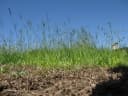
Paspalum notatum
Paspalum notatum
Safety & Hazards
None known
Cultivation Details
A plant of the tropical and subtropical zones, where it is found at elevations up to 2,000 metres. It grows best in areas where annual daytime temperatures are within the range 18 - 30°c, but can tolerate 5 - 36°c[1]. When dormant, the roots of the plant can survive temperatures down to about -10°c, but young growth can be severely damaged at -1°c[1]. It prefers a mean annual rainfall in the range 900 - 2,100mm, but tolerates 750 - 2,500mm[1]. Although not ideally adapted to the lowland tropics, it has potential for use in plantation crops because of its tolerance to moderate shade[2]. Grows best with a little shade, but can succeed in full sun and also in quite dense shade - it is very tolerant of shade and 35% higher yield has been measured under 50% shade than in full sunligh[2, 1]. Prefers a light soil, but succeeds in a wide range of soils, including those of low fertility[1]. Prefers a pH in the range 5 - 6.2, tolerating 4.3 - 8.3[1]. The plant has good drought tolerance; has been known to survive 36 days of flooding; and has some salt tolerance[2]. Plants can invade pastures and become weeds[1]. Viable seed is spread through dissemination in faeces[2]. Poor seedling competitiveness limits the plant's spread, but once it is established, it spreads strongly by virtue of the stout ground-appressed stolons, and strong root system[3]. Dry matter yields are usually between 3 - 8 tonnes per hectare, but can be up to 20 tonnes[1].
Propagation
Seed - freshly harvested seed mostly has a high level of dormancy that breaks down over a period of up to 3 years. Hammer-milling dormant seed or treatment with sulphuric acid helps to break dormancy. However, machine-harvested seed from the previous season is usually suitable for sowing. Seedlings develop slowly, so to minimise competition, a clean, weed-free seedbed is required. Seed should be placed up to 1cm deep (or on the surface), and rolled with a heavy roller. Seed is normally sown at 2 - 5 kg/ha[3]. Division of stolon pieces. Cite as: Tropical Plants Database, Ken Fern. tropical.theferns.info. 2026-02-20. <tropical.theferns.info/viewtropical.php?id=Paspalum+notatum>
Pollinators
Wind
References
- [1]Ecocrop — http://ecocrop.fao.org/ecocrop/srv/en/home ↩︎Basic information on a wide range of useful plants, plus details of environmental needs where available.
- [2]Plant Resources of Southeast Asia — http://proseanet.org/ ↩︎Lots of information on the uses of the plants of SE Asia.
- [3]Tropical Forages — http://www.tropicalforages.info/key/Forages/Media/Html/index.htm ↩︎Mainly focussed on forage plants, the site gives a lot of information on the plant, with a good botanical description, details of cultivation, plant uses and a good selection of photographs.