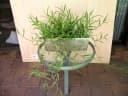
Paspalum conjugatum
Paspalum conjugatum
Cultivation Details
Paspalum conjugatum has a wide range of climatic tolerance, growing wild in the tropics and subtropics and spreading widely as a weed outside its range. It is best adapted to humid climates[1]. Succeeds in a wide range of habitats, growing well in full sun to moderate shade, in a wide range of soils including acidic, low-nutrient soils, and in wet as well as drier soils[3]. Often grown in pastures and as a lawn, the plant escapes from cultivation and has become widely naturalized outside its native range. The small seeds are probably distributed by humans and animals on clothing and fur, whilst small parts of the stolons can root to form new plants. It is regarded as an important weed in rice and plantation crops, and is a common and aggressive weed in pasture land in Australia. It grows vigorously under partial shade and may compete seriously with tree crops - it has been stated that some native forests have become extinct due to this pest[3, 1, 4]. Flowering commences 4 - 5 weeks after seedling emergence, and the plant continues to flower all year round[2]. New shoots develop at every rooted node[2].
References
- [1]Plant Resources of Southeast Asia — http://proseanet.org/ ↩︎Lots of information on the uses of the plants of SE Asia.
- [2]Grassland Species - Profiles — http://www.fao.org/ag/AGP/AGPC/doc/Gbase/Default.htm ↩︎Terse information on over 650 species of plants that grow in grassland, including trees, shrubs and perennial plants as well as grasses. Gives a brief description of the plant, its range and habitat and some of its uses.
- [3]Pacific Island Ecosystems at Risk — http://www.hear.org/pier/scientificnames/index.html ↩︎A very good website detailing weed species that have been introduced into the Pacific Islands.
- [4]Australian Tropical Rainforest Plants — http://www.anbg.gov.au/cpbr/cd-keys/rfk/index.html ↩︎An online resource giving botanical information, and a little bit about plant usage, for over 2,700 species of plants found in the Australian rainforest.
- [5]Philippine Medicinal Plants — http://www.stuartxchange.org/CompleteList.html ↩︎A lovely site, giving brief details on the medicinal uses of several hundred (over 400 at the last count) plants in the Philippines, plus a picture of each plant.