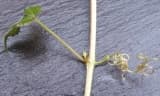
Parthenocissus semicordata
Parthenocissus semicordata
Safety & Hazards
None known
Cultivation Details
Parthenocissus semicordata is a plant of the warm temperate and subtropical zones of Asia. It is not very cold-hardy, tolerating occasional, short-lived temperatures falling as low as -5°c. The young growth in spring is more frost-tender and can be damaged by late frosts[1, 2]. Requires a well-drained moisture retentive fertile soil and a sunny position[1]. Succeeds in semi-shade[3]. In areas close to the limits of hardiness, the plant is best sited in a position that is sheltered from the morning sun - a west-facing wall is ideal, allowing the plant plenty of afternoon sun. A climbing plant, supporting itself by means of adhesive tendrils[4, 2]. A very good climber for walls but it can invade gutters[4]. Fruits are only produced after a long hot summer[2]. The fruit of this species is very late ripening and the plant has potential in breeding programmes with Vitis vinifera, especially in the Himalayas, where this trait could be useful[5].
Propagation
Seed - best sown as soon as it is ripe in a cold frame[1]. Stored seed requires stratifying for 6 weeks at 5°c and should be sown as early in the year as possible[1]. Germination is variable. When they are large enough to handle, prick the seedlings out into individual pots and grow them on in the greenhouse for at least their first winter. Plant them out into their permanent positions in late spring or early summer, after the last expected frosts. Cuttings of half-ripe wood, 7 - 10cm taken at a node (ensure that it has at least 2 true buds), mid summer in a frame[6]. Easy to root but they do not always survive the first winter[4]. Basal hardwood cuttings of current seasons growth, 10 - 12 cm long, autumn in a frame[1]. Layering[1]. Cite as: Temperate Plants Database, Ken Fern. temperate.theferns.info. 2026-02-21. <temperate.theferns.info/plant/Parthenocissus+semicordata>
Pollinators
Insects
References
- [1]The New RHS Dictionary of Gardening. 1992. — Huxley. A. · MacMillan Press · 1992 · ISBN 0-333-47494-5 ↩︎Excellent and very comprehensive, though it contains a number of silly mistakes. Readable yet also very detailed.
- [2]Gardening on Walls — Grey-Wilson. C. & Matthews. V. · Collins · 1983 · ISBN 0-00-219220-0 ↩︎A nice little book about plants for growing against walls and a small section on plants that can grow in walls.
- [3]Plants for Ground Cover — Thomas. G. S. · J. M. Dent & Sons · 1990 · ISBN 0-460-12609-1 ↩︎An excellent detailled book on the subject, very comprehensive.
- [4]Ornamental Shrubs, Climbers and Bamboos. — Thomas. G. S. · Murray · 1992 · ISBN 0-7195-5043-2 ↩︎Contains a wide range of plants with a brief description, mainly of their ornamental value but also usually of cultivation details and varieties.
- [5]Wild Fruits of the Sub-Himalayan Region. — Parmar. C. and Kaushal. M.K. · Kalyani Publishers. New Delhi. · 1982 · ISBN - ↩︎Contains lots of information on about 25 species of fruit-bearing plants of the Himalayas, not all of them suitable for cool temperate zones.
- [6]Propagation of Trees, Shrubs and Conifers. — Sheat. W. G. · MacMillan and Co · 1948 · ISBN - ↩︎A bit dated but a good book on propagation techniques with specific details for a wide range of plants.
- [7]Plantae Wilsonae. Vol 1 - 3 — Wilson. E. H. · University Press; Cambridge. · 1911 - 1917 · http://www.biodiversitylibrary.org ↩︎Details of the palnts collected by the plant collector E. H. Wilson on his travels in China. Gives some habitats. Not for the casual reader. It can be downloaded from the internet.
- [8]Flora of China — Missouri Botanical Garden Press; St. Louis. · 1994 · http://flora.huh.harvard.edu/china/ ↩︎An excellent, comprehensive resource in 25 volumes. In addition to the botanical information the flora also gives basic information on habitat and some uses. An on-line version is also available.
- [9]Plants and People of Nepal — Manandhar. N. P. · Timber Press. Oregon. · 2002 · ISBN 0-88192-527-6 ↩︎Excellent book, covering over 1,500 species of useful plants from Nepal together with information on the geography and peoples of Nepal. Good descriptions of the plants with terse notes on their uses.
- [10]Tanaka's Cyclopedia of Edible Plants of the World. — Tanaka. T. & Nakao S. · Keigaku Publishing; Tokyo · 1976 · ISBN - ↩︎The most comprehensive list of edible plants I've come across. Only the briefest entry for each species, though, and some of the entries are more than a little dubious. Not for the casual reader.
- [11]Plants for Human Consumption. — Kunkel. G. · Koeltz Scientific Books · 1984 · ISBN 3874292169 ↩︎An excellent book for the dedicated. A comprehensive listing of Latin names with a brief list of edible parts.
- [12]Ethnobotany of India Volume 4 Western and Central Himalayas — Pullaiah T. et al (Editors) · Apple Academic Press Inc.; Oakville, Canada · 2018 · ISBN 13: 978-1-77188-5 ↩︎
- [13]Indian Medicinal Plants; An Illustrated Dictionary — Khare C.P. (Ed.) · Springer-Verlag Berlin/Heidelberg · 2007 · ISBN 978-0-387-70637-5 ↩︎
- [PFAF]Plants for a Future — pfaf.org ↩︎