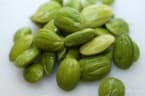
Parkia speciosa
Parkia speciosa
Safety & Hazards
None known
Cultivation Details
A plant of the lowland humid tropics at an elevation below 1,400 metres[1]. It grows best in areas with a mean minimum and maximum temperature within the range 20 - 28°c, but can tolerate 16 - 36°c. It prefers a mean annual rainfall in the range 1,000 - 2,000mm, but tolerates 800 - 2,500mm[1, 2]. Young plants require some shade from bright sunlight[1], but they become more light-demanding as they grow larger[2]. Prefers well drained loamy or clay-loam soils, but is also found in waterlogged soils[1]. Prefers a pH in the range 5.5 - 7, but tolerates 5 - 7.5[2]. Trees commence flowering when about 15 metres tall[3]. Trees can take up to 7 years from seed until they begin to crop[1]. Trees propagated by cuttings bloom and set fruit after only a few years[1]. This species has a symbiotic relationship with certain soil bacteria, these bacteria form nodules on the roots and fix atmospheric nitrogen. Some of this nitrogen is utilized by the growing plant but some can also be used by other plants growing nearby[4].
Propagation
Seed - needs to be sown as soon as possible because it has a short viability[1]. Fresh, soft seeds can be sown immediately, pre-soak any with harder skins for 24 hours in warm water prior to sowing. The seed is often sown in situ, with about 90% germinating within 3 - 15 days[1]. Cuttings of ripe wood Budding Cite as: Tropical Plants Database, Ken Fern. tropical.theferns.info. 2026-02-20. <tropical.theferns.info/viewtropical.php?id=Parkia+speciosa>
Pollinators
Bats
References
- [1]World Agroforesty Centre — http://www.worldagroforestry.org/ ↩︎An excellent online database of a huge range of trees giving very good information on each plant - its uses, ecology, identity, propagation, pests etc.
- [2]Ecocrop — http://ecocrop.fao.org/ecocrop/srv/en/home ↩︎Basic information on a wide range of useful plants, plus details of environmental needs where available.
- [3]Flora Malesiana Series 1 — Various · Nationaal Herbarium Nederiand, Universiteit Leiden branch · http://www.archive.org ↩︎A massive treatment of the plants of the Malaysian Archipelago. Much of it has been made available to download from the Internet
- [4]Nodulation Plants in GRIN Taxonomy — United States Department of Agriculture · http://www.ars-grin.gov/~sbmljw/cgi-bin/taxnodul.pl?language=en ↩︎An online database listing plants that have either positive or negative reports on root and stem nodulation with nitrogen-fixing bacteria.
- [5]Mansfeld's Database of Agricultural and Horticultural Plants — http://mansfeld.ipk-gatersleben.de/pls/htmldb_pgrc/f?p=185:3:4292127278597336 ↩︎Terse details of a huge range of useful plants.
- [6]Under-Utilized Tropical Fruits of Thailand. RAP — Suranant Subhadrabandhu · F. A. O., The United Nations, Bangkok. · 2001 · http://www.fao.org/3/a-ab777e.pdf ↩︎A detailed report on 35 fruit species that could have potential for increased production in Thailand. The report can be downloadd as a PDF from the internet.
- [7]Cornucopia II — Facciola. S. · Kampong Publications, California. · 1998 · ISBN 0-9628087-2-5 ↩︎The second edition of an excellent guide to the edible uses of plants, though it does not give any details of cultivation etc.
- [8]Perennial Edible Fruits of the Tropics : an Inventory — Martin, F. W.; Campbell, C. W.; Rubertbe, R. M. · U.S. Dept. of Agriculture, Agricultural Research Service · 1987 ↩︎A booklet giving terse details of almost 300 species of edible fruits, plus regional lists of Botanical and Common names for over 2,500 less well-known edible fruits of the tropics.
- [9]Plant Resources of Southeast Asia — http://proseanet.org/ ↩︎Lots of information on the uses of the plants of SE Asia.