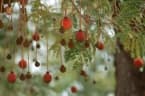
Parkia biglobosa
Parkia biglobosa
Safety & Hazards
The bark and pods contain substances toxic to fish - the alkaloid parkine that occurs in the pods and bark may be responsible[1].
Cultivation Details
Adapted to a wide ecological range, African locust bean is found naturally in the drier lowland tropics at elevations below 600 metres[2]. It grows best in areas where annual daytime temperatures are within the range 28 - 40°c, but can tolerate 8 - 44°c[3]. It prefers a mean annual rainfall in the range mm, but tolerates mm[3]. It prefers a strongly seasonal climate with a dry season of 4 - 8 months[1, 2]. Grows best in a sunny position[3]. Prefers well-drained, deep, sandy to loamy cultivated soils, but it is also found on shallow, skeletal soils and thick laterites[1, 3]. Prefers a pH in the range 4.5 - 5.5, tolerating 4 - 6[3]. The plant has a deep taproot system and an ability to restrict transpiration, this gives it the capacity to withstand drought conditions once it is established[1]. Young trees have a slow rate of growth[4]. Growth is comparatively fast: seedlings may reach a height of 1 metre within the first year, and young trees of superior provenances can reach 7 metres tall in 6-year-old plantations[5]. Trees start flowering at 5 - 7 years while still comparatively small. They reach their maximum height after 30 - 50 years, and can reach an age of 100 years[5]. Trees in some areas have two flowering periods each year[5]. The tree produces root suckers[4]. There are conflicting reports on whether or not this tree has a symbiotic relationship with certain soil bacteria, so it is unclear as to whether this tree fixes atmospheric nitrogen[6].
Propagation
Seed - it has a hard seedcoat and benefits from scarification before sowing in order to speed up and improve germination. This can usually be done by pouring a small amount of nearly boiling water on the seeds (being careful not to cook them!) and then soaking them for 12 - 24 hours in warm water. By this time they should have imbibed moisture and swollen - if they have not, then carefully make a nick in the seedcoat (being careful not to damage the embryo) and soak for a further 12 hours before sowing. The plant forms two different types of seed in each pod, reddish-dark ones and black ones[1]. The reddish dark have thinner seed coats and germinate more easily and quickly, even without scarification[1]. Young plants quickly form a deep taproot so it is best to sow the seed in individual, deep containers. Usually about 75% of all the seeds will germinate[1]. Seedlings can be ready to plant in their permanent positions when they are 10 - 14 weeks old[4]. Cuttings of mature wood[1]. Grafting. Cite as: Tropical Plants Database, Ken Fern. tropical.theferns.info. 2026-02-20. <tropical.theferns.info/viewtropical.php?id=Parkia+biglobosa>
Pollinators
Bats, Bees, Insects
References
- [1]World Agroforesty Centre — http://www.worldagroforestry.org/ ↩︎An excellent online database of a huge range of trees giving very good information on each plant - its uses, ecology, identity, propagation, pests etc.
- [2]Seed Leaflets — Various · Forest & Landscape. Denmark · http://en.sl.life.ku.dk/Publikationer/Udgivelser/PopulaerPublikationer.aspx?katid={D28373CC-6EF3-4EF8-B097-6D83FABF209E}&serieid={9F1C3DB1-6E7B-4CF1-AF53-F480B0CB40EF}&sort=title ↩︎A series of leaflets, jointly produced by the University of Copenhagen and the Royal Botanic Gardens at Kew, focussing on seed information for a number species, but also giving a lot of other information about each plant.
- [3]Ecocrop — http://ecocrop.fao.org/ecocrop/srv/en/home ↩︎Basic information on a wide range of useful plants, plus details of environmental needs where available.
- [4]Trees and Shrubs of the Sahel. Their Characteristics and Uses. — von Maydell H. · Deutsche Gesellschaft fur Technische Zusammenarbeit; Germany · 1990 · ISBN 3-8236-1198-4 ↩︎A well-researched book, usually with more than one photograph of each species and good information on the plant and its uses.
- [5]Protabase - Plant Resources of Tropical Africa. — http://www.prota.org ↩︎An excellent on-line database with detailed information on over 3,200 species of useful plants of Africa.
- [6]Nodulation Plants in GRIN Taxonomy — United States Department of Agriculture · http://www.ars-grin.gov/~sbmljw/cgi-bin/taxnodul.pl?language=en ↩︎An online database listing plants that have either positive or negative reports on root and stem nodulation with nitrogen-fixing bacteria.
- [7]Mansfeld's Database of Agricultural and Horticultural Plants — http://mansfeld.ipk-gatersleben.de/pls/htmldb_pgrc/f?p=185:3:4292127278597336 ↩︎Terse details of a huge range of useful plants.
- [8]Dictionary of Economic Plants. — Uphof. J. C. Th. · Weinheim · 1959 · ISBN - ↩︎An excellent and very comprehensive guide but it only gives very short descriptions of the uses without any details of how to utilize the plants. Not for the casual reader.
- [9]Cornucopia II — Facciola. S. · Kampong Publications, California. · 1998 · ISBN 0-9628087-2-5 ↩︎The second edition of an excellent guide to the edible uses of plants, though it does not give any details of cultivation etc.