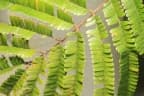
Parkia bicolor
Parkia bicolor
Safety & Hazards
None known
Cultivation Details
A plant of the moist tropics where it is found at elevations up to 1,200 metres[1]. It occurs in regions with a mean annual rainfall of 2,000 - 4,000mm, and with a dry season of up to 3 months[1]. Requires a sunny position[1]. Seedlings can become 1 metre tall in their first year of growth[1]. In Cote d'Ivoire, the mean annual growth in diameter is about 7mm for trees with a diameter at breast height of 10 - 70cm in natural forest stands, and 17mm per year in 14-year-old plantations[1]. Individual trees flower for 6 - 8 weeks. At night, the sterile flowers near the base of the inflorescence produce abundant nectar, which attracts bats. The flowers are probably most commonly pollinated by these bats, but dormice and pottos have also been recorded as feeding on the nectar[1]. Fruits develop in about 2 months[1]. Regeneration is fairly common in secondary forest[1]. Although many species within the family Fabaceae have a symbiotic relationship with soil bacteria, this species is said to be devoid of such a relationship and therefore does not fix atmospheric nitrogen[2].
Propagation
Seed - it loses its viability rapidly and should be sown fresh. Removal of the seed coat improves germination. Germination occurs 4 - 10 days after sowing. The seedlings are sensitive to damping off[1]. Cite as: Tropical Plants Database, Ken Fern. tropical.theferns.info. 2026-02-20. <tropical.theferns.info/viewtropical.php?id=Parkia+bicolor>
Pollinators
Bats
References
- [1]Protabase - Plant Resources of Tropical Africa. — http://www.prota.org ↩︎An excellent on-line database with detailed information on over 3,200 species of useful plants of Africa.
- [2]Nodulation Plants in GRIN Taxonomy — United States Department of Agriculture · http://www.ars-grin.gov/~sbmljw/cgi-bin/taxnodul.pl?language=en ↩︎An online database listing plants that have either positive or negative reports on root and stem nodulation with nitrogen-fixing bacteria.
- [3]Mansfeld's Database of Agricultural and Horticultural Plants — http://mansfeld.ipk-gatersleben.de/pls/htmldb_pgrc/f?p=185:3:4292127278597336 ↩︎Terse details of a huge range of useful plants.
- [4]IUCN Red List of Threatened Species — http://www.iucnredlist.org/ ↩︎A list of plants under threat and facing possible extinction, usually with brief details of the threats and information on habitat.