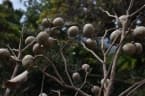
Chrysobalanaceae FAMILY
Parinari excelsa
Parinari excelsa
Edibility
3/5
Medicinal
3/5
Safety & Hazards
None known
Cultivation Details
HabitEvergreen Tree
GrowthFast
A plant mainly of moist, tropical lowlands where it can be found at elevations up to 1,000 metres[1]. Grows well in sandy soils[2]. Plants are not resistant to fire[3]. In areas of managed forestry, it appears difficult to control and it tends to suppress desirable tree species present with it[1]. Variable in shape, size and texture of leaves, in type of indumentum (cf. Above), in form of inflorescence, and in size of flowers[3].
Propagation
Seed - Cite as: Tropical Plants Database, Ken Fern. tropical.theferns.info. 2026-02-20. <tropical.theferns.info/viewtropical.php?id=Parinari+excelsa>
Pollinators
Bees
References
- [1]The Useful Plants of West Tropical Africa. — Burkil. H. M. · Royal Botanic Gardens; Kew. · 1985 - 2004 ↩︎Brief descriptions and details of the uses of over 4,000 plants. A superb, if terse, resource, it is also available electronically on the Web - see http://www.aluka.org/
- [2]Edible Wild Plants of Tanzania — Ruffo, C.K.: Birnie, A. & Tengnas, B. · Regional Land Management Unit; Nairobi. · 2002 · ISBN 9966-896-60-0 ↩︎A very well presented, simple guide to growing and utilizing wild food plants in Tanzania, with line drawings of each plant, a description, habitat and range, non-food as well as food uses, plus basic information on growing the plants.
- [3]African Flowering Plants Database — Conservatoire et Jardin Botaniques. · http://www.ville-ge.ch/musinfo/bd/cjb/africa/recherche.php ↩︎Contains information on over 150,000 plant names (including synonyms) giving a description and habitat, plus a distribution map.
- [4]Fruits of the Guianan Flora — van Roosmalen. M.G.M. · Institute of Systematic Boyany, Utrecht University; Netherlands. · 1985 · ISBN 90-9000988-4 ↩︎Terse descriptions of over 1,700 species from the Guianas that bear fruits - not necessarily edible! Often mentions if the fruit is edible, plus gives brief description of habit and habitat.
- [5]Field Guide to the Moist Forest Trees of Tanzania. — Lovett J.C.; Ruffo C.K.; Gereau R.E.; Taplin J.R.D · Frontier · http://www.york.ac.uk/res/celp/webpages/projects/ecology/tree%20guide/introduction.htm · ISBN 1-873070-33-0 ↩︎A lovely little book giving a basic identification guide to more than 650 species of trees growing in Tanzania. It is also available to view on the internet.
- [6]Dictionary of Economic Plants. — Uphof. J. C. Th. · Weinheim · 1959 · ISBN - ↩︎An excellent and very comprehensive guide but it only gives very short descriptions of the uses without any details of how to utilize the plants. Not for the casual reader.
- [7]Journal of Ethnopharmacology. Vol. 37, pp179 - 196 — Bourdy. G. & Walter. A. · Elsevier Scientific Publishers; Ireland. · 1992 ↩︎Information on various herbs used to facilitate childbirth in Vanuatu. Available to download as a PDF document from the Internet.