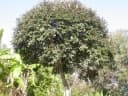
Parinari curatellifolia
Parinari curatellifolia
Safety & Hazards
None known
Cultivation Details
A plant of the tropical and subtropical savannah, growing at elevations of 900 - 1,500 metres in areas with a pronounced dry season[1]. It grows best in areas where the mean annual temperature falls within the range 14 - 30°c, but can tolerate 10 - 36°c[2]. It prefers a mean annual rainfall in the range 400 - 1,000mm, tolerating 100 - 2,700mm[2]. Prefers a deep soil in a sunny position[3]. Grows best in light soils[4]. Often found on light yellowish-brown to reddish-yellow, gritty, sandy clay loams and red to dark red friable clays with lateritic horizon[2]. Prefers a pH in the range 5.5 - 7, but tolerates 5 - 7.5[2]. It can tolerate small concentrations of copper in the soil[2]. Dislikes cold winds[2]. Trees can be coppiced[5]. Because of its resistance to fire it features prominently in fire-maintained wooded grassland, especially in upland areas on the former site of montane forest[6].
Propagation
Seed - it remains viable in normal storage for at least 4 years[5]. The seeds should be sown in river sand in flat seed trays. Press the seeds down until they are level with the soil surface and cover with a thin layer of sand. Germination is very poor and prolonged, commencing after about 5 weeks. Seedlings should be transplanted in the 3-leaf stage. Be careful when transplanting the seedlings, the taproot is easily damaged[5]. Plant out when about 30cm tall. Root suckers. Cite as: Tropical Plants Database, Ken Fern. tropical.theferns.info. 2026-02-20. <tropical.theferns.info/viewtropical.php?id=Parinari+curatellifolia>
Pollinators
Bees
References
- [1]Useful Plants of Nyasaland — Williamson J. · The Government Printer, Zomba, Nyasaland. · 1955 · http://www.biodiversitylibrary.org ↩︎Brief details of the uses of almost 500 species of plants.
- [2]Ecocrop — http://ecocrop.fao.org/ecocrop/srv/en/home ↩︎Basic information on a wide range of useful plants, plus details of environmental needs where available.
- [3]Tropical and Subtropical Trees - A Worldwide Encyclopaedic Guide. — Barwick. M. · Thames & Hudson, London · 2004 · ISBN 0-500-51181-0 ↩︎A superb book, very concise and well written, giving a wealth of information on 400 or more species including descriptions, habitat, cultivation details and plant uses. A wealth of colour photographs bring each plant vividly to life.
- [4]Perennial Edible Fruits of the Tropics : an Inventory — Martin, F. W.; Campbell, C. W.; Rubertbe, R. M. · U.S. Dept. of Agriculture, Agricultural Research Service · 1987 ↩︎A booklet giving terse details of almost 300 species of edible fruits, plus regional lists of Botanical and Common names for over 2,500 less well-known edible fruits of the tropics.
- [5]Seed Leaflets — Various · Forest & Landscape. Denmark · http://en.sl.life.ku.dk/Publikationer/Udgivelser/PopulaerPublikationer.aspx?katid={D28373CC-6EF3-4EF8-B097-6D83FABF209E}&serieid={9F1C3DB1-6E7B-4CF1-AF53-F480B0CB40EF}&sort=title ↩︎A series of leaflets, jointly produced by the University of Copenhagen and the Royal Botanic Gardens at Kew, focussing on seed information for a number species, but also giving a lot of other information about each plant.
- [6]Flora Zambesiaca — http://apps.kew.org/efloras/fz/intro.html ↩︎An excellent online flora of plants from the Zambezi River basin. It lists a number of the plant uses as well as the habitats and botanical descriptions of the plants.
- [7]Edible Wild Plants of Tanzania — Ruffo, C.K.: Birnie, A. & Tengnas, B. · Regional Land Management Unit; Nairobi. · 2002 · ISBN 9966-896-60-0 ↩︎A very well presented, simple guide to growing and utilizing wild food plants in Tanzania, with line drawings of each plant, a description, habitat and range, non-food as well as food uses, plus basic information on growing the plants.
- [8]Dictionary of Economic Plants. — Uphof. J. C. Th. · Weinheim · 1959 · ISBN - ↩︎An excellent and very comprehensive guide but it only gives very short descriptions of the uses without any details of how to utilize the plants. Not for the casual reader.
- [9]World Agroforesty Centre — http://www.worldagroforestry.org/ ↩︎An excellent online database of a huge range of trees giving very good information on each plant - its uses, ecology, identity, propagation, pests etc.