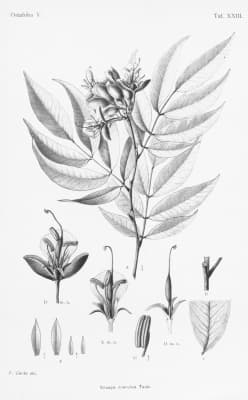
Paramacrolobium coeruleum
Paramacrolobium coeruleum
Safety & Hazards
None known
Cultivation Details
Seedlings should be planted out in the full sun and in fertile soils to obtain good growth[1]. When grown in the nursery, seedlings are about 30cm tall after 4 months and 60cm tall after 15 months[1]. In Guinea, 6-year-old saplings showed a mean annual height growth of 85 - 130cm, but in DR Congo planted trees were only 4.5 metres tall after 11 years and had a high mortality[1]. Fruits are eaten by monkeys and large rodents, which may serve as seed dispersers[1]. Although the distribution of this species is notably discontinuous, it does not seem correlated with any important geographical variation[2]. Although many species within the family Fabaceae have a symbiotic relationship with soil bacteria, this species is said to be devoid of such a relationship and therefore does not fix atmospheric nitrogen[3].
Propagation
Seed - pre-treatment is not needed, but soaking in cold water for 1 - 2 days or in nearly boiling water for a few minutes speeds up the germination process[1]. Seeds can be stored for at least 18 months, when the viability is still about 40%[1]. Cite as: Tropical Plants Database, Ken Fern. tropical.theferns.info. 2026-02-20. <tropical.theferns.info/viewtropical.php?id=Paramacrolobium+coeruleum>
Pollinators
Data unavailable
References
- [1]Protabase - Plant Resources of Tropical Africa. — http://www.prota.org ↩︎An excellent on-line database with detailed information on over 3,200 species of useful plants of Africa.
- [2]Flora of Tropical East Africa — Beentje H.J. · Royal Botanic Gardens; Kew. · 2002 · http://plants.jstor.org/search?st=396814 ↩︎Available on-line, a modern flora of East Africa.
- [3]Nodulation Plants in GRIN Taxonomy — United States Department of Agriculture · http://www.ars-grin.gov/~sbmljw/cgi-bin/taxnodul.pl?language=en ↩︎An online database listing plants that have either positive or negative reports on root and stem nodulation with nitrogen-fixing bacteria.
- [4]African Flowering Plants Database — Conservatoire et Jardin Botaniques. · http://www.ville-ge.ch/musinfo/bd/cjb/africa/recherche.php ↩︎Contains information on over 150,000 plant names (including synonyms) giving a description and habitat, plus a distribution map.
- [5]Field Guide to the Moist Forest Trees of Tanzania. — Lovett J.C.; Ruffo C.K.; Gereau R.E.; Taplin J.R.D · Frontier · http://www.york.ac.uk/res/celp/webpages/projects/ecology/tree%20guide/introduction.htm · ISBN 1-873070-33-0 ↩︎A lovely little book giving a basic identification guide to more than 650 species of trees growing in Tanzania. It is also available to view on the internet.