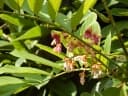
Paraderris elliptica
Paraderris elliptica
Safety & Hazards
The plant contains rotenone and has been used traditionally as a fish poison - the rotenone kills or stuns the fish making them easy to catch, but the fish remain perfectly edible for mammals. Rotenone is classified by the World Health Organization as moderately hazardous. It is mildly toxic to humans and other mammals, but extremely toxic to many insects (hence its use as an insecticide) and aquatic life, including fish. This higher toxicity in fish and insects is because the lipophilic rotenone is easily taken up through the gills or trachea, but not as easily through the skin or the gastrointestinal tract. The lowest lethal dose for a child is 143 mg/kg, but human deaths from rotenone poisoning are rare because its irritating action causes vomiting. Deliberate ingestion of rotenone, however, can be fatal. The compound decomposes when exposed to sunlight and usually has an activity of six days in the environment. The leaves are said to be poisonous enough to kill cattle[1].
Cultivation Details
A plant mainly found in humid, lowland tropical areas, though it can also be grown at elevations up to 1,500 metres. It grows best in areas where annual daytime temperatures are within the range 24 - 30°c, but can tolerate 20 - 36°c[1]. It prefers a mean annual rainfall in the range 1,800 - 3,500mm, but tolerates 1,400 - 5,000mm[1]. It can survive dry periods of up to 4 months[1]. Prefers a position in full sun or in light shade[1]. Succeeds in most well-drained soils of at least moderate fertility[1]. Prefers a pH in the range 5.5 - 7, tolerating 4.3 - 8.6[1]. Plants can commence flowering when about 18 months old[2]. Maximum yield of roots is achieved when the plant is 18 - 25 months old. Most of the roots (usually more than 90%) are found in the top 45cm of soil[3]. The yield of air-dried roots is 1,100 - 1,800 kg/ha, occasionally up to 3,000 kg/ha, particularly when plants are trellised[2, 3]. Yield of rotenone from the roots is usually 5 - 6%, though with selected cultivars this can rise to 13%[3]. There is a danger of soil erosion during the first few months after planting and again after harvesting, therefore land suitable for this crop should either be flat or only slightly sloping[1]. Several cultivars (mostly clones of this vegetatively propagated crop) are widespread in cultivation and have bean selected for high rotenone content (13% of the roots)[4]. This species has a symbiotic relationship with certain soil bacteria; these bacteria form nodules on the roots and fix atmospheric nitrogen. Some of this nitrogen is utilized by the growing plant but some can also be used by other plants growing nearby[3].
Propagation
Seed - Cite as: Tropical Plants Database, Ken Fern. tropical.theferns.info. 2026-02-20. <tropical.theferns.info/viewtropical.php?id=Paraderris+elliptica>
Pollinators
Data unavailable
References
- [1]Ecocrop — http://ecocrop.fao.org/ecocrop/srv/en/home ↩︎Basic information on a wide range of useful plants, plus details of environmental needs where available.
- [2]World Agroforesty Centre — http://www.worldagroforestry.org/ ↩︎An excellent online database of a huge range of trees giving very good information on each plant - its uses, ecology, identity, propagation, pests etc.
- [3]The Leguminosae; A Source Book of Characteristics, Uses and Nodulation — Allen O.N.; Allen E.K. · University of Wisconsin · 1981 · ISBN 0-333-32221-5 ↩︎An amazing and comprehensive work, giving a brief guide to the many genera of the family Fabaceae and also the principle uses of the genus.
- [4]Mansfeld's Database of Agricultural and Horticultural Plants — http://mansfeld.ipk-gatersleben.de/pls/htmldb_pgrc/f?p=185:3:4292127278597336 ↩︎Terse details of a huge range of useful plants.
- [5]Plant Resources of Southeast Asia — http://proseanet.org/ ↩︎Lots of information on the uses of the plants of SE Asia.